FDA Clears Leucovorin for an Ultra-Rare Disorder — Not for Autism
What You Need to Know at a Glance
-
The FDA has approved leucovorin for a very rare genetic condition, not for autism.
-
The newly approved use is for cerebral folate deficiency linked to a FOLR1 gene variant, an ultra-rare disorder affecting fewer than 1 in 1 million people.
-
Earlier comments from Trump administration officials had created the impression that the drug could help large numbers of autistic children.
-
FDA officials now say the evidence is not strong enough to approve leucovorin as an autism treatment.
-
One of the biggest studies often cited in support of leucovorin for autism was recently retracted after problems were found in the reported data.
-
After the White House publicly promoted the drug last year, prescriptions surged, making it harder for some families to get the medication.
-
Some parents say they have already started treatment and believe it is helping their children, but medical experts say the science remains uncertain and limited.
FDA Approves Leucovorin for a Rare Brain Folate Disorder, Not Autism
The US Food and Drug Administration has approved leucovorin for a highly unusual genetic disorder that affects how folate reaches the brain. But the agency stopped far short of approving the drug for autism, despite earlier public statements that had raised expectations among many families.
The newly cleared use applies only to people with cerebral folate deficiency caused by a confirmed FOLR1 gene variant. This condition is extremely rare. Health officials say it affects fewer than one in a million people, and only a small number of cases have been described worldwide.
That makes the decision important for a tiny patient group. At the same time, it also marks a clear pullback from earlier messaging that suggested leucovorin might soon become a broader treatment option for children with autism.
Why This Decision Matters
Leucovorin is not a new medicine. It has been used for years in other medical settings, including reducing side effects from certain chemotherapy drugs. What changed this week is its label.
The FDA has now recognized the drug as a treatment for a rare disorder in which folate, a form of vitamin B essential for brain development and nervous system function, does not properly reach the brain. In these patients, folate levels in the blood may appear normal, but the brain is still not getting what it needs.
That can lead to serious neurological problems, including developmental delay, seizures, movement issues, and symptoms that may resemble autism.
This is where confusion began. Because some signs overlap, public statements last year created the impression that leucovorin might be on track to become an FDA-backed treatment for autism itself. The new decision makes clear that this is not what the evidence currently supports.
What Officials Said Before — and What the FDA Says Now
Last September, senior Trump administration officials publicly highlighted leucovorin as a promising therapy that could potentially help many autistic children. At the time, FDA Commissioner Dr. Marty Makary and Health and Human Services Secretary Robert F. Kennedy Jr. pointed to research suggesting that some autistic children may have biological problems involving folate transport to the brain.
The theory is that certain antibodies may block folate from crossing into the brain in some patients. Based on that idea, officials suggested the drug could benefit a much broader group than those with the ultra-rare genetic condition.
But FDA officials now say their formal review did not support that broader conclusion.
According to agency officials, the strongest available data only justified approval for the rare genetic form of cerebral folate deficiency tied to the FOLR1 mutation. They said there is currently not enough evidence to establish that leucovorin works for autism more broadly.
In other words, the FDA’s final position is much narrower than the public impression created last fall.
Why the Autism Approval Did Not Happen
The main reason is evidence.
FDA officials said the science supporting leucovorin for autism is still too limited. Some smaller studies have suggested that it may help communication or behavior in certain children, especially those with signs of folate-related metabolic differences. But those studies have not been enough to support a formal approval for autism.
The issue became even more complicated when the largest randomized, double-blind, placebo-controlled study often cited in favor of leucovorin for autism was retracted after errors were found in the reported data.
That matters because randomized controlled trials are usually considered the strongest standard for showing whether a drug truly works. Without reliable, high-quality evidence, the FDA could not justify expanding the label to include autism.
Professional medical groups have also taken a cautious position. The available evidence, they say, may point to possible benefit in selected cases, but it is far from strong enough for routine use in autistic children.
What Is Cerebral Folate Deficiency in FOLR1?
Cerebral folate deficiency linked to the FOLR1 gene is an ultra-rare neurological disorder. The gene defect interferes with proteins responsible for moving folate into the brain.
Folate is critical for brain growth, nerve function, and development. When the brain cannot get enough of it, patients may develop serious problems such as:
Common features may include:
-
Seizures
-
Developmental delay
-
Problems with movement or coordination
-
Speech difficulties
-
Neurological symptoms that can resemble autistic features
Doctors and researchers say this condition is not the same thing as autism, even though there can be overlap in symptoms.
Experts familiar with the disorder have said there is no direct overlap between the rare genetic disease itself and autism as a broader diagnosis. That distinction is one of the key reasons the FDA limited the approval.
Why the Approval Was Unusual
Another notable part of this decision is how the FDA reached it.
Normally, drug approvals rely on large clinical trials that compare a medicine against a placebo or another treatment. In this case, the agency said that the approach was difficult because the disorder is so rare and because reported patient responses to the drug have sometimes been dramatic.
Instead, the approval was based on a systematic review of published medical literature, including case reports and mechanistic evidence.
FDA officials said children with this gene-related folate disorder have shown major improvements with leucovorin in reported cases. Some reportedly became seizure-free, while others improved so significantly that withholding treatment in a randomized trial could raise ethical concerns.
That kind of evidence would not usually be enough for a broader condition like autism, but regulators considered it acceptable for such an exceptionally rare disease.
Prescriptions Spiked After the White House Promotion
Even before this week’s FDA action, the public discussion around leucovorin had already changed prescribing patterns.
A recent paper in The Lancet found that prescriptions for the drug rose sharply after the White House briefing in September. In children ages 5 to 17, prescribing was reported to be significantly above normal in the months that followed.
That spike created real-world consequences.
Some families reported difficulty finding doctors willing to prescribe the drug. Others struggled to locate pharmacies that had it in stock. In some cases, parents turned to non-prescription folate products when prescription leucovorin became hard to obtain.
Researchers who tracked the surge said they were not surprised. High-level government messaging can strongly influence public demand, especially when parents are searching for answers in a condition as emotionally and medically complex as autism.
Families Are Now Left With More Questions
For some parents, the FDA’s narrower approval feels like a painful reversal.
Families who fought to obtain the drug after last year’s public statements are now worried about what happens next. They are asking whether doctors will continue prescribing it off-label, whether pharmacies will keep stocking it, and whether insurance companies will still cover it.
Some parents say they have already seen changes in their children after starting treatment. Those personal experiences are powerful and meaningful to families. But from a regulatory standpoint, individual improvement stories do not replace the need for strong clinical evidence.
That tension is now at the center of the leucovorin debate: hope on one side, and the need for rigorous proof on the other.
Can Doctors Still Prescribe It Off-Label?
Yes, in many cases, doctors can still prescribe FDA-approved drugs for uses not listed on the label. That is known as off-label prescribing.
So while the FDA did not approve leucovorin for autism, that does not automatically prevent physicians from using it in selected patients if they believe it may help.
Still, off-label use comes with important limits. Insurance coverage may be inconsistent. Access may remain difficult. And the absence of FDA approval for autism means the scientific case remains unresolved.
The Bigger Picture
This FDA decision does two things at once.
First, it gives formal recognition to a treatment for a devastating and ultra-rare genetic disorder that previously had no FDA-approved option. For that small patient population, the approval is a genuine milestone.
Second, it draws a firm line around the evidence. Despite earlier public enthusiasm, the agency is not endorsing leucovorin as a treatment for autism.
That distinction matters. It affects families, doctors, insurers, supply chains, and the broader public conversation around autism therapies.
For now, the message from regulators is clear: leucovorin has gained FDA approval for a narrowly defined rare disorder, but the science does not yet support approval for autism as a whole.
Why the FDA Limited the Approval
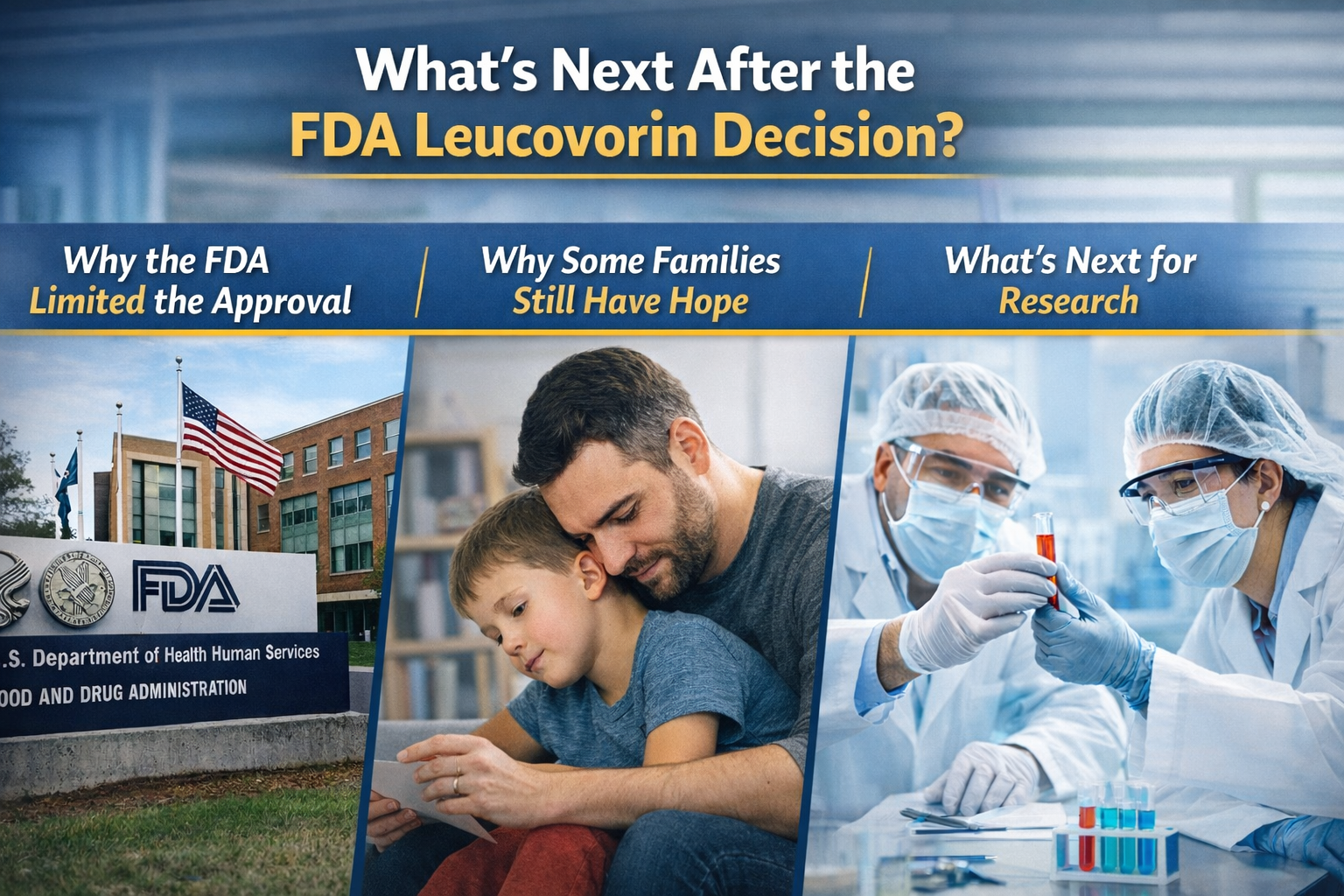
The FDA approved leucovorin only for a rare genetic form of cerebral folate deficiency, saying the available evidence did not support a broader approval for autism. The decision draws a clear line between the agency’s final review and earlier public statements that had raised expectations among families looking for new treatment options.
Why Some Families Are Still Holding On to Hope
Even without FDA approval for autism, some parents say they believe the drug is helping their children. Families who have already started treatment report changes in speech, communication, and behavior, though those accounts remain personal experiences rather than proof of effectiveness across a wider population.
What Comes Next for Research
Researchers will now face pressure to answer a more specific question: whether leucovorin may help a defined subgroup of autistic children. Future studies will likely focus on identifying which patients have folate-related abnormalities and whether any benefits can be confirmed in stronger clinical trials.
References:
- https://www.pbs.org/newshour/health/fda-finds-little-evidence-that-the-generic-drug-leucovorin-can-help-people-with-autism
- https://thehill.com/policy/healthcare/5776232-fda-approves-wellcovorin-utra-rare-disease-trump-admin-autism/
- https://edition.cnn.com/2026/03/10/health/fda-leucovorin-update-autism-folate-deficiency