What Grocery List Supports a 1,500 Calorie Weight Loss Plan?

20 Warning Signs of Diabetes + A1C Levels, Symptoms & New Types Explained

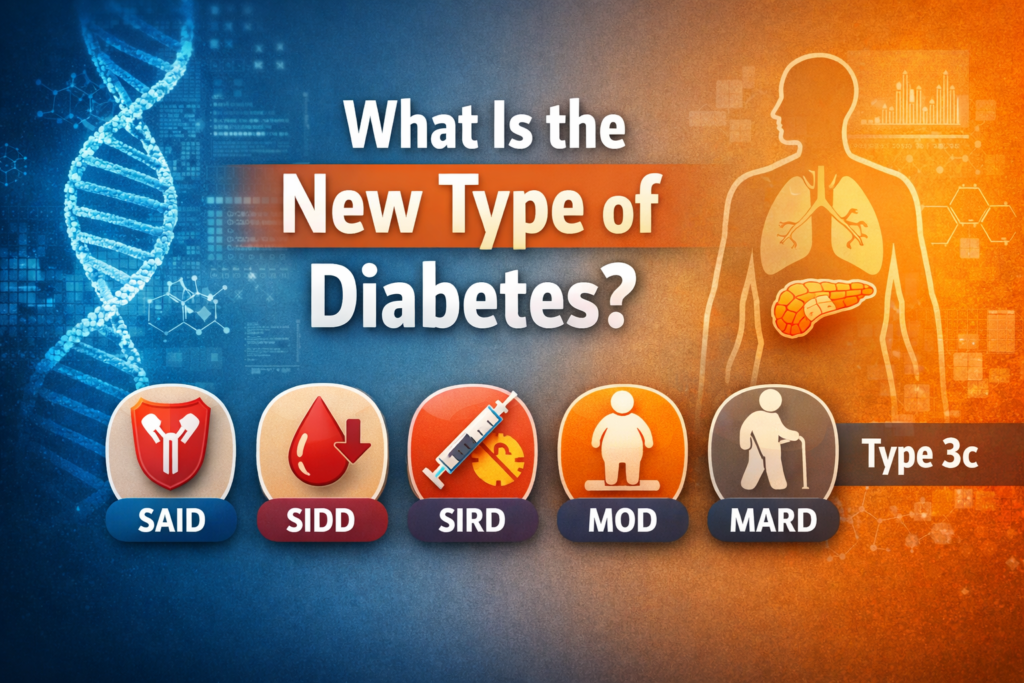
What Are the Warning Signs, A1C Levels, and Key Indicators of Diabetes? Diabetes is one of the most common chronic diseases worldwide, and many people live with it for years without knowing. According to the World Health Organization, over 420 million people globally have diabetes, and a significant portion remains undiagnosed. The most important thing to understand is this: diabetes often starts silently but gives warning signs if you know what to look for. This guide breaks down those signs, explains A1C levels, and helps you recognize when to take action. What are the 20 warning signs of diabetes? The 20 warning signs of diabetes include frequent urination, excessive thirst, fatigue, blurred vision, and slow-healing wounds. These symptoms happen because high blood sugar disrupts normal body functions. Common early and advanced warning signs: Frequent urination (polyuria) Excessive thirst (polydipsia) Increased hunger (polyphagia) Unexplained weight loss Fatigue or weakness Blurred vision Slow-healing wounds Frequent infections Dry skin Tingling or numbness in hands/feet Dark patches on skin (acanthosis nigricans) Irritability Headaches Bad breath (fruity smell in severe cases) Nausea or vomiting Recurrent yeast infections Reduced concentration Increased nighttime urination Erectile dysfunction (in men) Vision changes over time Why these occur:High blood glucose damages blood vessels and nerves, leading to widespread symptoms across multiple body systems. What are the early warning signs vs late symptoms of diabetes? Early signs are subtle (thirst, fatigue), while late symptoms involve complications like nerve damage and vision loss. Early signs: Mild fatigue Increased thirst Slight weight changes Frequent urination Late-stage symptoms: Nerve pain (neuropathy) Vision problems (retinopathy) Kidney issues Chronic infections Key insight: Early detection can prevent most complications. What do the 5 C’s of diabetes mean? The 5 C’s of diabetes are common symptoms: excessive urination, thirst, hunger, fatigue, and blurry vision. The 5 C’s explained: Constant urination → kidneys remove excess sugar Constant thirst → dehydration from fluid loss Constant hunger → cells lack usable glucose Chronic fatigue → low energy utilization Cloudy vision → fluid shifts in eye lenses These are classic textbook indicators doctors use for initial screening. What does undiagnosed diabetes feel like? Undiagnosed diabetes often feels like persistent fatigue, brain fog, and unexplained body changes that don’t improve. Common experiences: Always tired, even after rest Feeling “off” or mentally slow Frequent infections Increased thirst without a clear cause Subtle weight loss or gain Important: Many people ignore these symptoms because they develop gradually. What is the A1C level for diabetes diagnosis? An A1C level of 6.5% or higher is used to diagnose diabetes. According to the American Diabetes Association: A1C Level Meaning Below 5.7% Normal 5.7% – 6.4% Prediabetes 6.5% or higher Diabetes What A1C measures:It reflects your average blood sugar over the past 2–3 months, not just a single reading. What is a normal A1C vs prediabetes vs diabetes? A normal A1C is below 5.7%, while diabetes starts at 6.5% or higher. Quick comparison: Normal: < 5.7% Prediabetes: 5.7–6.4% Diabetes: ≥ 6.5% Why it matters:Even prediabetes significantly increases the risk of developing full diabetes if not addressed. What is the A1C goal for a 70-year-old? For most healthy adults aged 70, the A1C goal is typically below 7.0–7.5%, depending on overall health. Individualized targets: Healthy older adults: < 7–7.5% Multiple conditions: < 8% Frail individuals: < 8–8.5% Why goals differ:Older adults are at higher risk of hypoglycemia (low blood sugar), so targets are slightly relaxed. How does A1C vary by age and health condition? A1C targets become less strict with age and comorbidities to balance safety and control. Factors affecting A1C goals: Life expectancy Risk of hypoglycemia Heart disease Kidney function Medication type Key idea: Diabetes care is personalized, not one-size-fits-all. What are the newer research-based subtypes of diabetes? Newer research-based subtypes of diabetes are five biologically distinct clusters identified in adults with newly diagnosed diabetes: SAID, SIDD, SIRD, MOD, and MARD. These clusters were proposed to move beyond the simple “type 1 vs. type 2” model by grouping people according to autoimmune status, insulin production, insulin resistance, age at diagnosis, body size, and blood sugar control. The five cluster-based subtypes are: SAID (Severe Autoimmune Diabetes): This group resembles classic autoimmune diabetes. People in this cluster tend to have positive GAD antibodies, an earlier onset, poor insulin production, and a clinical picture similar to type 1 diabetes or LADA. SIDD (Severe Insulin-Deficient Diabetes): This subtype is marked by low insulin secretion and high HbA1c at diagnosis. Research has linked it to poorer glucose control and a higher risk of diabetic retinopathy. SIRD (Severe Insulin-Resistant Diabetes): This group is defined by marked insulin resistance. Follow-up studies have found that it is associated with a higher risk of diabetic kidney disease and fatty liver–related complications. MOD (Mild Obesity-Related Diabetes): This subtype usually includes people with obesity but without the same degree of severe insulin resistance seen in SIRD. It is generally considered a milder phenotype than the severe subgroups. MARD (Mild Age-Related Diabetes): This cluster tends to appear in older adults and usually has a comparatively milder metabolic profile at diagnosis. This classification matters because different clusters appear to carry different risks for complications and may eventually support more personalized treatment. In the original Lancet study, the authors concluded that this five-cluster model could be a first step toward precision medicine in diabetes, because disease progression and complication risk were not the same across all groups. At the same time, these clusters are not the standard day-to-day diagnostic system used in routine clinical guidelines. Current ADA classification still organizes diabetes into major clinical categories such as type 1 diabetes, type 2 diabetes, gestational diabetes, and other specific types due to other causes, including monogenic diabetes and diabetes caused by exocrine pancreatic disease or medications. How are modern classifications of diabetes changing? Modern research is shifting diabetes classification from 3 types to multiple subgroups based on biology. Key changes: Focus on insulin resistance vs deficiency Use of genetic and metabolic markers More precise treatment approaches Insight: Diabetes is not a single disease—it’s

20 Warning Signs of Diabetes + A1C Levels, Symptoms & New Types Explained Read More »

How to lower blood sugar quickly

How to Lower Blood Sugar Quickly (10-Minute, Immediate & 24-Hour Methods)

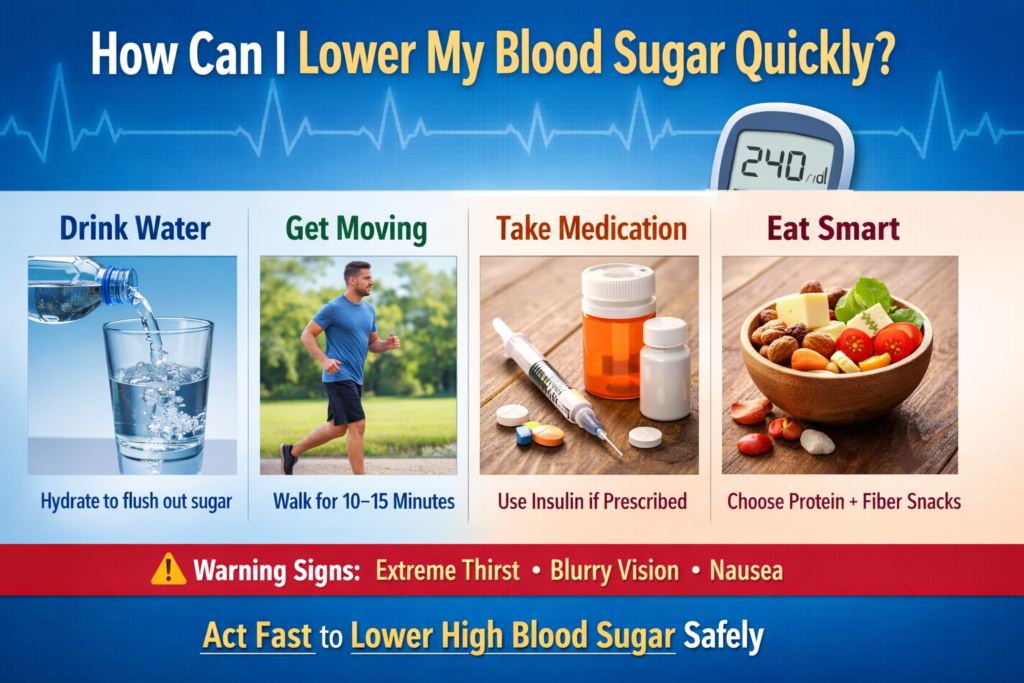
How Can I Lower My Blood Sugar Quickly? If your blood sugar is high, the fastest way to lower it safely is through hydration, light physical activity, and (if prescribed) medication like insulin. These methods work by helping your body either use glucose or remove excess sugar from the bloodstream. High blood sugar—also called hyperglycemia—can happen after eating too many refined carbs, missing medication, stress, or illness. According to the Centers for Disease Control and Prevention, consistently high blood sugar increases the risk of heart disease, kidney damage, and nerve problems. This guide gives you practical, evidence-based steps you can use immediately, within minutes, and over the next 24 hours. What brings down blood sugar immediately? The fastest ways to lower blood sugar immediately are drinking water, taking a short walk, and using prescribed insulin if needed. These methods work quickly because they either: Help your body use glucose (exercise) Help flush excess glucose through urine (hydration) Directly lower glucose (medication) Immediate actions you can take: Drink water (1–2 glasses): Helps the kidneys remove excess glucose Walk for 10–15 minutes: Muscles use glucose for energy Take insulin (if prescribed): Most effective for rapid control Avoid eating more carbs: Prevents further spikes 👉 Research shows that even light activity after meals can reduce post-meal glucose spikes. Can you lower blood sugar in 10 minutes? Yes, you can start lowering blood sugar within 10 minutes, but a significant reduction usually takes 30–60 minutes. The fastest short-term impact comes from movement and hydration. What works in 10 minutes: Brisk walking or climbing stairs Drinking water Deep breathing (reduces stress hormones) What does NOT work instantly: Eating “healthy foods” (takes time to digest) Supplements claiming instant results “Detox” drinks 👉 Exercise begins improving glucose uptake almost immediately because muscles pull sugar from the blood without needing as much insulin. How can I flush sugar out of my system fast? You cannot literally “flush sugar out instantly,” but you can help your body remove excess glucose faster through hydration and urination. What actually works: Drink water regularly Stay hydrated throughout the day Support kidney function naturally What is a myth: Detox drinks Lemon water “flushing sugar.” Herbal cures act instantly 👉 The body naturally regulates sugar through: Insulin Kidneys Liver No shortcut bypasses this system. What drinks bring blood sugar down? The best drinks for lowering blood sugar are water, unsweetened tea, and certain low-calorie beverages that improve insulin sensitivity. Best drinks: Water (most effective) Helps eliminate excess glucose through urine Green tea Contains antioxidants linked to improved insulin sensitivity Black coffee (unsweetened) May improve glucose metabolism ([research it and add it from your own, Insert study]) Apple cider vinegar (diluted) Some studies show it may reduce post-meal glucose spikes Drinks to avoid: Soda Fruit juice Energy drinks Sweetened tea Drink Type Effect on Blood Sugar Water Lowers Green tea Supports control Soda Raises sharply Juice Raises quickly What is the number one snack to lower blood sugar? The best snack to stabilize blood sugar is a combination of protein and fiber, such as nuts or Greek yogurt. These foods slow down digestion and prevent spikes. Top snack options: A handful of almonds or walnuts Greek yogurt (unsweetened) Boiled eggs Peanut butter with apple slices Chia pudding Why these work: Protein slows glucose absorption Fiber reduces spikes Healthy fats improve satiety 👉 According to the American Diabetes Association, balanced snacks help prevent rapid blood sugar fluctuations. How do I lower my blood sugar in 24 hours? You can significantly lower blood sugar within 24 hours by combining diet, hydration, movement, and medication adherence. 24-hour action plan: Morning Drink water Eat a high-protein breakfast Take medications as prescribed Daytime Walk after meals Avoid refined carbs Stay hydrated Evening Eat a light, balanced dinner Avoid late-night snacking Key principles: Reduce carb load Increase activity Stay consistent 👉 Studies show that diet and activity changes can improve glucose levels within a single day. What should you avoid when your blood sugar is high? Avoid anything that causes rapid glucose spikes or worsens insulin resistance. Avoid immediately: Sugary drinks White bread, rice, pasta Fried foods Large meals Skipping medication Why this matters: These foods cause sharp spikes followed by crashes, making control harder. When should you seek medical help for high blood sugar? Seek medical help if blood sugar is persistently above 300 mg/dL or accompanied by symptoms. Warning signs: Extreme thirst Frequent urination Blurred vision Nausea or vomiting Confusion These may indicate serious conditions like diabetic ketoacidosis (DKA). What are the most common mistakes when trying to lower blood sugar fast? The biggest mistakes include relying on myths, skipping medication, and overcorrecting. Common errors: Drinking sugary “health” drinks Ignoring medication Overeating “healthy carbs.” Panic eating Better approach: Stay calm Use proven methods Monitor glucose levels Key Takeaways The fastest way to lower blood sugar is water + movement + medication (if prescribed) You can start lowering it in 10–15 minutes, but the full effect takes longer There is no instant “flush” solution Protein + fiber snacks help stabilize glucose Consistency over 24 hours makes a big difference FAQs How fast can blood sugar drop? Blood sugar can begin dropping within 10–15 minutes, but noticeable changes usually take 30–60 minutes. Does drinking water lower blood sugar immediately? Yes, water helps lower blood sugar by aiding kidney function and glucose excretion. Can exercise lower blood sugar quickly? Yes, even light activity like walking can reduce blood sugar within minutes. What is the fastest natural way to lower blood sugar? Hydration and physical activity are the fastest natural methods. Is fasting good for lowering blood sugar quickly? Short-term fasting may help, but it should be done carefully and not without guidance if you have diabetes. Can I bring my blood sugar down without medication? Yes, mild spikes can often be managed with diet and activity, but medication is necessary for many people. What is dangerously high blood sugar? Levels above 300 mg/dL are considered dangerous and require medical attention. Need Diabetes

How to Lower Blood Sugar Quickly (10-Minute, Immediate & 24-Hour Methods) Read More »

Understanding diabetes_ triggers and rules

What Makes Diabetes Worse? Complete Guide to Triggers, Worst Foods, and Safe Management Rules

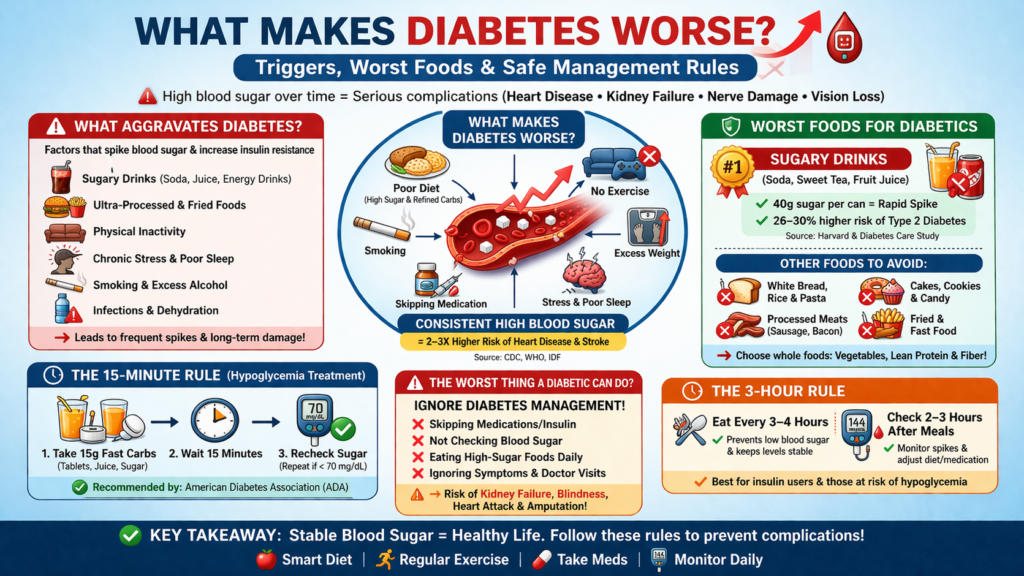
What Makes Diabetes Worse? Comprehensive Guide to Triggers, Worst Foods, and Safe Management Rules Diabetes doesn’t worsen overnight—it happens gradually when blood sugar stays uncontrolled for long periods. The biggest drivers are diet, lifestyle habits, and inconsistent management. If you understand what triggers blood sugar spikes and insulin resistance, you can prevent complications and live a healthy life. According to the World Health Organization (WHO), global diabetes prevalence has risen from about 7% in 1990 to 14% in 2022, largely due to poor diet and inactivity. That makes understanding these triggers more important than ever. What makes diabetes worse over time? Diabetes worsens when blood sugar remains consistently above target levels, leading to damage in organs like the heart, kidneys, eyes, and nerves. When glucose stays high: Blood vessels become damaged Insulin becomes less effective Complications develop faster Key factors that worsen diabetes: Frequent high blood sugar (hyperglycemia) Poor diet (high sugar and refined carbs) Lack of physical activity Excess body weight Smoking Poor sleep Skipping medications 📊 Research insight:The Centers for Disease Control and Prevention (CDC) states that people with diabetes are 2–3 times more likely to develop heart disease than those without it. What aggravates diabetes and causes blood sugar spikes? Diabetes is aggravated by anything that increases insulin resistance or causes rapid glucose spikes. These triggers make it harder to keep blood sugar stable. Common aggravating factors: Ultra-processed foods Sugary drinks Refined carbohydrates Stress Infections Dehydration Alcohol (in excess) Why these factors matter: They increase glucose absorption speed They reduce insulin sensitivity They cause frequent spikes and crashes How stress plays a role: Stress hormones like cortisol increase blood sugar levels—even without eating. What is the number one worst food for diabetics? The worst food group for diabetics is sugary drinks, including soda, sweetened tea, energy drinks, and fruit juices. Why sugary drinks are harmful: They contain high amounts of sugar (≈40g per soda) They are absorbed very quickly They lack fiber and protein Result: Rapid glucose spikes Increased insulin demand Higher long-term risk 📊 Research finding:A meta-analysis published in Diabetes Care found that people consuming high amounts of sugary drinks had about a 26–30% higher risk of developing type 2 diabetes. Why do sugary drinks spike blood sugar faster than solid foods? Liquids digest faster because they require little breakdown, leading to immediate glucose absorption. In contrast: Solid foods digest more slowly Fiber slows sugar release Protein reduces spikes What foods should you avoid if you have diabetes? People with diabetes should avoid foods that cause rapid blood sugar spikes or worsen insulin resistance. High-risk food categories: Food Type Examples Why It’s Harmful Sugary drinks Soda, juice, energy drinks Rapid glucose spikes Refined carbs White bread, rice, pasta High glycemic index Sweets Cakes, cookies, candy Sugar + refined flour Processed meats Sausages, bacon Linked to insulin resistance Fried foods Fast food, fries High fat + inflammation Additional foods to limit: Sweetened yogurt Breakfast cereals (processed) Packaged snacks 📊 Evidence:A study in The BMJ found that higher consumption of refined grains is associated with increased diabetes risk. What is the 15-minute rule in diabetes? The 15-minute rule is used to treat mild hypoglycemia (low blood sugar) safely. How it works: Take 15 grams of fast-acting carbs Glucose tablets 120 ml juice 1 tablespoon sugar or honey Wait 15 minutes Recheck blood sugar Repeat if still below 70 mg/dL Why it’s important: Prevents severe hypoglycemia Avoids overcorrecting (which causes spikes) This method is recommended by the American Diabetes Association (ADA). What is the 3-hour rule in diabetes? The 3-hour rule means not going longer than 3–4 hours without eating (for some patients) and checking blood sugar 2–3 hours after meals. Two common uses: 1. Eating interval rule: Prevents low blood sugar Keeps glucose stable 2. Post-meal monitoring: Check blood sugar after 2–3 hours Helps adjust diet or insulin Why it matters: Post-meal spikes (postprandial glucose) are linked to: Heart disease Long-term complications What is the worst thing a diabetic can do? The worst thing a diabetic can do is ignore blood sugar management consistently. Dangerous behaviors include: Skipping medications or insulin Eating high-sugar foods regularly Not monitoring blood glucose Ignoring symptoms Avoiding medical care Why this is dangerous: Leads to chronic hyperglycemia Increases complication risk 📊 Global impact:According to the International Diabetes Federation (IDF), diabetes caused 6.7 million deaths in 2021. Why is skipping medication dangerous? Skipping medication disrupts blood sugar control and can lead to severe complications quickly. It can cause: Sudden glucose spikes Diabetic ketoacidosis (in type 1) Organ damage over time How do lifestyle habits affect diabetes control? Lifestyle habits directly influence blood sugar, insulin sensitivity, and overall disease progression. Positive habits: Regular exercise Balanced diet Adequate sleep Stress management Negative habits: Sedentary lifestyle Smoking Chronic stress Sleep deprivation 📊 Research insight:The Diabetes Prevention Program (NIH study) showed lifestyle changes reduced diabetes risk by 58%. What are the long-term risks of poorly controlled diabetes? Uncontrolled diabetes leads to serious complications affecting multiple organs. Major complications: Heart disease Stroke Kidney failure Vision loss Nerve damage Amputations Why complications happen: High glucose damages blood vessels Inflammation increases Organs lose function Key Takeaways Diabetes worsens due to high blood sugar over time Sugary drinks are the worst dietary trigger Lifestyle habits play a major role The 15-minute rule treats low blood sugar The 3-hour rule helps maintain stability Ignoring management is the most dangerous behavior FAQs What causes sudden spikes in blood sugar? Sudden spikes are caused by sugary foods, stress, illness, or skipping medication. Can stress worsen diabetes? Yes, stress increases cortisol, which raises blood sugar levels. Is fruit bad for diabetes? Whole fruit is generally safe in moderation, but fruit juice should be limited. How often should diabetics eat? Many people benefit from eating every 3–4 hours, but this depends on treatment plans. What is a safe blood sugar level? Typically, 70–130 mg/dL before meals and less than 180 mg/dL after meals (ADA guidelines). Can diabetes be reversed? Type 2 diabetes can sometimes be put

What Makes Diabetes Worse? Complete Guide to Triggers, Worst Foods, and Safe Management Rules Read More »

Vegetables diabetics should limit and enjoy

What Vegetables Should Diabetics Avoid? (Complete Guide)

What Vegetables Should Diabetics Avoid? If you have diabetes, you don’t need to avoid vegetables entirely—but some vegetables should be limited because they can raise blood sugar quickly. These are usually starchy vegetables or processed vegetable products. Most vegetables are healthy, but understanding carbohydrates, glycemic index, and portion size is key to managing blood glucose effectively. According to the American Diabetes Association (ADA), non-starchy vegetables should make up a large portion of your meals, while starchy ones should be eaten in moderation. What makes certain vegetables bad for diabetics? Vegetables become problematic for diabetics when they are high in carbohydrates and have a high glycemic index (GI). These factors can cause rapid spikes in blood sugar. Key factors that matter: High carbohydrate content → raises glucose levels High glycemic index (GI) → causes faster sugar spikes Low fiber → less blood sugar control Processing (e.g., frying) → increases unhealthy effects 📊 According to Harvard T.H. Chan School of Public Health, foods with a high GI are digested quickly, leading to faster increases in blood sugar levels. Which vegetables should diabetics limit or avoid? Diabetics should mainly limit starchy vegetables and processed vegetable products, not all vegetables. Here are the key categories: High-starch vegetables High GI vegetables Processed vegetable foods Overcooked vegetables Are potatoes bad for diabetics? Yes—potatoes can raise blood sugar quickly, especially when fried or mashed. Potatoes are high in carbohydrates and have a high glycemic index. Examples: Boiled potatoes → moderate GI Mashed potatoes → higher GI French fries → very high GI + unhealthy fats 📊 Research published in the American Journal of Clinical Nutrition found that frequent potato consumption is associated with increased risk of type 2 diabetes. 👉 Better approach: Eat smaller portions Pair with protein or fiber Choose sweet potatoes in moderation Is corn safe for people with diabetes? Corn is not harmful, but it should be eaten in moderation. Corn is a starchy vegetable with higher carbohydrate content than leafy greens. Key points: Contains fiber (which helps) Still raises blood sugar if overeaten Corn products (like cornflakes) are worse 👉 Tip: Stick to ½ cup servings and combine with protein. Should diabetics avoid peas and other starchy vegetables? Peas, lentils, and similar vegetables are nutritious but can raise blood sugar if consumed in large amounts. Examples of starchy vegetables: Green peas Chickpeas Lentils Butternut squash These foods: Provide fiber and protein Still contains significant carbs 👉 The goal is moderation—not elimination. Are beets and carrots high in sugar? No, beets and carrots are often misunderstood. They contain natural sugars but are generally safe in normal portions. Why they’re okay: Low to moderate glycemic index High in fiber Rich in nutrients 📊 According to the ADA, non-starchy vegetables like carrots are safe and beneficial for blood sugar control. 👉 Exception: Avoid large quantities of beet juice (high sugar concentration). Are processed vegetable products harmful? Yes—processed vegetable products are often worse than whole vegetables. These include: French fries Potato chips Vegetable crisps Canned vegetables with added sugar Why they’re harmful: Added fats and salt Reduced fiber Faster glucose spikes 👉 Whole vegetables are always the better choice. What is the difference between starchy and non-starchy vegetables? Starchy vegetables contain more carbohydrates and can raise blood sugar faster, while non-starchy vegetables have minimal impact. Comparison Table: Type Examples Carb Content Blood Sugar Impact Starchy vegetables Potatoes, corn, peas High Moderate to high Non-starchy vegetables Spinach, broccoli, and cucumber Low Minimal 👉 According to the CDC, non-starchy vegetables should fill half your plate. How does the cooking method affect blood sugar levels? Cooking methods can significantly change how vegetables affect blood sugar. Key insights: Boiling → moderate impact Steaming → best option Frying → increases GI and calories Overcooking → breaks down fiber, raises GI 👉 Example: Raw carrot → low GI Cooked carrot → higher GI 👉 Tip: Choose light cooking methods like steaming or sautéing. What vegetables are safe and recommended for diabetics? Non-starchy vegetables are the safest and most beneficial. Best options: Leafy greens (spinach, kale) Broccoli Cauliflower Cabbage Zucchini Bell peppers 📊 The ADA recommends these because they are: Low in carbs High in fiber Rich in vitamins How much of high-carb vegetables can diabetics safely eat? Diabetics can eat starchy vegetables—but portion control is essential. General guideline: ½ cup cooked starchy vegetables per meal Smart strategies: Pair with protein (chicken, fish) Add healthy fats (olive oil) Avoid eating alone 👉 This helps slow glucose absorption. What are common mistakes diabetics make when eating vegetables? Many people misunderstand vegetables and diabetes. Common mistakes: Assuming all vegetables are safe Overeating starchy vegetables Drinking vegetable juices Choosing fried options Ignoring portion sizes 👉 Awareness is key to better blood sugar control. Key takeaway: What vegetables should diabetics avoid or limit? Diabetics should limit—not completely avoid—starchy and processed vegetables. Limit these: Potatoes (especially fried) Corn Peas Processed vegetable snacks Eat freely: Leafy greens Non-starchy vegetables 👉 The goal is balance, not restriction. FAQs Can diabetics eat potatoes at all? Yes, but in small portions and preferably boiled or baked—not fried. Are carrots safe for diabetics? Yes, carrots are safe and healthy when eaten in normal portions. Which vegetables spike blood sugar the most? Potatoes, corn, and processed vegetable products have the biggest impact. Is a sweet potato better than a regular potato? Yes, sweet potatoes generally have a lower glycemic index. Can diabetics eat vegetable soup? Yes, as long as it doesn’t contain added sugar or too many starchy vegetables. Are frozen vegetables safe? Yes, if they don’t contain added sauces or sugars. Should diabetics avoid all carbs from vegetables? No, carbohydrates are essential—focus on quality and portion control. Conclusion Managing diabetes doesn’t mean avoiding vegetables—it means choosing the right ones. Focus on non-starchy vegetables, control portions of starchy ones, and avoid processed options. With the right approach, vegetables can become one of the most powerful tools for controlling blood sugar and improving overall health.

What Vegetables Should Diabetics Avoid? (Complete Guide) Read More »

Steps to lose weight infographic

How Many Steps a Day to Lose Weight?

How Many Steps a Day to Lose Weight? Most people do not need a magical number like 10,000 steps a day to start losing weight. A more accurate answer is this: many adults can begin seeing weight-loss benefits by increasing daily movement into the roughly 7,000 to 10,000+ steps per day range, especially when walking is paired with a calorie-controlled diet and done at a brisk pace often enough to count as moderate-intensity activity. The reason this question is tricky is simple. Steps alone do not cause weight loss. Weight loss happens when your overall routine creates a calorie deficit over time, and walking is one practical way to increase daily calorie burn. The exact step number that works depends on your starting activity level, body size, speed, diet, age, and consistency. Walking matters because it is one of the easiest forms of exercise to sustain. It is low-cost, accessible for many people, and easier to recover from than harder forms of cardio. That makes it especially useful for beginners and for anyone trying to build habits that last. How many steps a day do you really need to lose weight? A practical target for weight loss is usually somewhere between 7,000 and 10,000+ steps per day, but the best target depends on how much you eat and how briskly you walk. For many people, 10,000 steps is a strong but optional target, not a requirement. What step range is realistic for most adults trying to lose weight? A useful way to think about daily steps is by range, not by one fixed number: Daily steps What it usually means Under 5,000 Low activity for many adults; usually not enough on its own for meaningful weight-loss momentum 5,000–7,000 A good improvement zone for beginners; may help, especially with diet changes 7,000–10,000 A realistic weight-loss range for many adults when paired with nutrition changes 10,000+ Often associated with better long-term results, especially when many steps are brisk 12,000+ May help some people create a larger calorie deficit, but not necessary for everyone This table reflects the broader pattern in official guidance and step research: more movement generally helps, but diet and intensity determine whether added steps translate into noticeable fat loss. Why is there no single perfect step number for everyone? There is no universal best step count because weight loss depends on total energy balance, not steps alone. Two people can walk the same number of steps and get very different results. Why do body size, pace, and diet change the result? Several factors change how effective walking is for fat loss: Body size: Larger bodies usually burn more calories per step than smaller bodies. Walking pace: Brisk walking raises heart rate and burns more energy than casual strolling. Terrain: Hills, stairs, and uneven surfaces increase effort. Diet: Walking helps, but overeating can erase the calorie deficit. Starting point: Someone going from 3,000 to 8,000 steps usually sees more impact than someone already averaging 9,000. Consistency: Results come from weeks and months, not a few high-step days. That is why “How many steps should I walk?” is really shorthand for a bigger question: How much daily movement do I need, along with better eating habits, to create a sustainable calorie deficit? What does research say about steps and weight loss? Research suggests that walking more helps with weight management, but the amount of weight lost from steps alone is often modest unless diet improves too. Studies also suggest that people who lose more weight tend to combine higher step counts with more moderate-to-vigorous walking. What do official physical activity guidelines recommend? U.S. guidance does not prescribe a specific daily step number. Instead, it recommends that adults get at least 150 minutes per week of moderate-intensity aerobic activity, such as brisk walking, plus muscle-strengthening activity at least 2 days per week. CDC also notes that people trying to lose weight and keep it off generally need a high amount of physical activity unless they also reduce calorie intake. That matters because steps are just one way to reach those active minutes. A person can hit 10,000 slow steps and still do less useful weight-loss activity than someone who walks fewer steps but at a brisk pace. What do step-count studies show about real-world outcomes? A meta-analysis of pedometer-based walking interventions in sedentary adults with overweight or obesity found that walking programs produced modest weight loss, around 1 kilogram on average, and longer programs tended to produce more loss. The same review estimated roughly 0.05 kg per week, which is useful but not dramatic. A clinical trial in previously sedentary adults with overweight or obesity found that a 10,000-step prescription led to weight loss over 36 weeks, with average changes including about 2.4 kg of body weight, lower BMI, lower fat mass, and a smaller waist. People who adhered better saw better body-composition results. Another study found that adults who successfully lost at least 10% of baseline body weight in a behavioral program were averaging about 10,000 steps per day, with roughly 3,500 of those steps performed as bouted moderate-to-vigorous activity. That suggests the quality of steps matters, not just the total. Is 10,000 steps a day necessary for fat loss? No. 10,000 steps is a useful benchmark, but it is not a medical rule and not a requirement for weight loss. Official activity guidelines are based on minutes and intensity, not on a fixed step count. The 10,000-step idea became popular partly as a simple public goal, but the evidence shows something more nuanced. For health outcomes in general, meaningful benefits often begin below 10,000 steps. A 2025 systematic review found that compared with 2,000 steps per day, 7,000 steps per day was associated with substantially lower risks across several health outcomes, including all-cause mortality and cardiovascular disease. That does not mean 7,000 steps guarantees weight loss. It means lower targets can still be meaningful, especially if they help someone move from sedentary to consistently active. Can you lose weight

How Many Steps a Day to Lose Weight? Read More »

Weight loss through walking journey

Why Is Walking So Effective for Weight Loss?

Why Is Walking So Effective for Weight Loss? Walking is the most popular form of physical activity worldwide and is specifically recommended as a weight management strategy by health researchers. A JAMA Network study found that aerobic exercise like walking creates a direct dose-response relationship with fat loss—meaning the more you walk, the more weight you lose. Here’s something interesting: Research from Southern Methodist University discovered that traditional calorie-burning equations underestimate walking’s effectiveness in 97% of cases. You’re actually burning more calories than most fitness trackers tell you! Studies also show that people who maintain long-term weight loss through walking develop a better “walking economy”—their bodies are more efficient at burning energy during movement than those of individuals with obesity. Food Calorie Calculator How Many Steps Should You Walk Daily for Weight Loss? The magic number backed by science? 10,000 steps per day combined with proper nutrition. An 18-month clinical study published in the Journal of the American College of Sports Medicine found that participants who achieved 10% or greater weight loss were consistently hitting approximately 10,000 total steps daily. The research revealed: Each additional 1,000 steps resulted in an extra 0.21 kg of weight loss Each additional 1,000 moderate-to-vigorous intensity steps led to 0.33 kg more weight loss The sweet spot is 10,000 total steps with 3,500 of those at moderate-to-vigorous intensity in bouts of at least 10 minutes Studies published in JAMA confirm that walking 10,000 steps can improve cardiovascular health and reduce risks of dementia and cancer better than any pill or injection currently available. How Long Should Your Walking Sessions Be for Maximum Fat Burning? Duration matters—but so does how you structure your walks. A 24-week study on women with excess weight found fascinating results: those who split their 50-minute daily walk into two 25-minute sessions lost 3.7 pounds (1.7 kg) more than those who walked continuously for 50 minutes. Breaking up your walks can actually boost results! For meaningful weight loss, aim for: Walking Goal Duration Expected Results Modest weight loss 30 minutes, 5x weekly Gradual fat reduction  Significant weight loss 250+ minutes weekly (~35 min daily) Clinically measurable results  Accelerated fat loss 50-60 minutes daily (split sessions) Enhanced weight loss with better adherence  Research shows that 30 minutes of brisk walking burns approximately 137 kcal (575 kJ) for someone at a healthy weight, compared to 205 kcal (857 kJ) for someone with obesity. What Walking Pace Burns the Most Calories for Weight Loss? Speed directly impacts your calorie burn. Here’s the breakdown per minute based on research data: Walking Speed Calories Burned Per Minute 2 mph (slow pace) 2.8–3.5 calories 3 mph (moderate) 3.5–4.8 calories 4 mph (brisk) 5.2–7.2 calories Surprisingly, a study in the Journal of Sports Medicine and Physical Fitness found that walking at 5 mph burns at least as many calories as jogging at the same pace—without the joint impact. Brisk walking (approximately 1.52 m/s or about 3.4 mph) is the optimal speed for fat burning while remaining sustainable for longer durations. What Are the Best Walking Techniques to Accelerate Weight Loss? To maximize your calorie burn and speed up results, try these proven strategies: Walk in intensity bursts – Alternate 2 minutes of fast walking with 1 minute of moderate pace; research shows interval walking increases fat oxidation Add inclines – Walking uphill engages more muscle groups and significantly increases energy expenditure Break walks into two sessions – Studies prove that splitting daily walks leads to 1.7 kg more weight loss than single sessions Hit 3,500 MVPA steps – Of your 10,000 daily steps, aim for at least 3,500 at moderate-to-vigorous intensity in 10-minute bouts for enhanced results Track your pace, not just steps – Calorie burn varies significantly based on speed, so focus on walking faster rather than just walking more How Does Walking Compare to Other Exercises for Weight Loss? Walking offers unique advantages that other exercises can’t match. Research from the University of Kansas Medical Center confirms that consistent walking delivers cardiovascular benefits that rival pharmaceutical interventions. Unlike high-intensity workouts, walking: Creates no metabolic disadvantage – Long-term weight loss maintainers who walk regularly show the same exercise efficiency as people who were never overweight Burns more calories than estimated – Traditional equations underpredict walking calorie expenditure by a significant margin Supports sustainable weight maintenance – Higher levels of walking are specifically linked to long-term weight loss maintenance success The bottom line: Walking 10,000 steps daily—with roughly 3,500 at a brisk intensity—combined with a calorie-controlled diet creates a powerful formula for lasting weight loss.

Why Is Walking So Effective for Weight Loss? Read More »

What Grocery List Supports a 1,500 Calorie Weight Loss Plan?

What Should Diabetics Eat? Best Foods, Worst Foods & Sugar Symptoms

What Should a Person With Diabetes Eat, Avoid, and Know About Sugar? Diabetes nutrition gets overcomplicated fast. One article says fruit is fine. Another says bananas are too sugary. Someone else says all carbs are bad. That kind of advice is exactly why so many people feel stuck. Here’s the simpler truth: diabetes-friendly eating is usually less about “never” foods and more about choosing foods that keep blood sugar steadier, improve fullness, and reduce sharp glucose spikes. The American Diabetes Association says carbohydrates have the biggest effect on blood sugar, and the NIDDK recommends building meals around non-starchy vegetables, fiber-rich carbs, and protein. This matters because diabetes is already very common. In the United States, about 40.1 million people have diabetes, or roughly 1 in 8, and more than 1 in 4 adults with diabetes don’t know they have it. What Are the Worst Foods for a Diabetic? The worst foods for diabetes are usually the ones that deliver a lot of fast-digesting carbohydrate with very little fiber. In plain language, that means foods and drinks that push blood sugar up quickly and don’t keep you full for long. The American Diabetes Association notes that foods high in simple carbs, fat, and calories tend to have a bigger impact on blood glucose, while Mayo Clinic specifically advises eating fewer refined, highly processed carbs such as white bread, white rice, sugary cereal, cakes, cookies, candy, and chips. Which foods usually spike blood sugar the fastest? Sugary drinks are at the top of the list. Soda, sweetened tea, energy drinks, and many packaged juices can raise blood sugar quickly because they contain rapidly absorbed sugars without the slowing effect of much fiber. The NIDDK explicitly recommends water instead of sugary drinks such as soda, sports drinks, and fruit juice. Refined grain foods also deserve extra caution. White bread, white rice, many bakery products, sweet cereals, and snack foods are typically lower in fiber and easier to digest quickly. That combination often means a sharper glucose rise than you’d get from beans, lentils, oats, or intact whole grains. What does the research say about sugary drinks and diabetes risk? Large studies consistently link sugar-sweetened beverages with higher type 2 diabetes risk. A major BMJ analysis found habitual intake of sugar-sweetened beverages was associated with greater incidence of type 2 diabetes, and a more recent global analysis in Nature Medicine also linked sugar-sweetened beverages to type 2 diabetes burden across countries. So, if you want a practical rule, it’s this: the worst foods for diabetes are usually liquid sugar, refined carbs, and heavily processed snack foods. What Foods Can a Diabetic Eat More Often Without Spiking Blood Sugar? No food is truly “free,” because portions still matter. But some foods are much easier to build meals around because they support steadier blood sugar and better fullness. The NIDDK’s plate method is one of the clearest frameworks: half the plate non-starchy vegetables, one-quarter protein, and one-quarter fiber-rich carbohydrate foods such as beans, fruit, brown rice, or whole grains. Which foods are the safest everyday staples? The easiest foods to eat more often include: Are non-starchy vegetables the best foundation? Yes. Leafy greens, broccoli, cauliflower, cabbage, peppers, okra, green beans, lettuce, cucumbers, and zucchini are some of the best everyday choices because they are lower in carbohydrate and higher in volume and nutrients. NIDDK specifically recommends making non-starchy vegetables half the plate. Are beans and lentils good for diabetes? Yes. Beans, chickpeas, and lentils offer carbohydrate, but they also bring fiber and protein, which usually makes them more blood-sugar-friendly than refined starches. The ADA includes beans and lentils among the “whole, minimally processed carbohydrate foods” people with diabetes can eat. Is protein helpful for steadier meals? Yes. Foods like eggs, fish, chicken, tofu, yogurt, and other lean proteins can make meals more filling and may reduce the chance that you’ll rely on high-sugar snacks later. The NIDDK includes protein foods as one-quarter of the plate. What does the evidence say about fiber and whole grains? This is where the data gets especially useful. A major review in PLOS Medicine reported that people with prediabetes, type 1 diabetes, or type 2 diabetes should aim to increase fiber by about 15 grams per day or up to about 35 grams per day, and one practical way to do that is replacing refined grains with whole grains. A BMJ analysis also found higher whole-grain intake was associated with lower type 2 diabetes risk. So if you want foods you can eat more comfortably, think: vegetables, beans, lentils, whole grains, nuts, seeds, and lean proteins. Are Bananas Okay for Diabetics? Yes, bananas can fit into a diabetes-friendly diet. The better question is not “Are bananas bad?” but “How much banana works for me?” The ADA includes banana in its list of common fruits, and Diabetes UK notes that a large banana contains about 30 grams of carbohydrate, which is why portion size matters. They also point out that whole fruit is generally a better target than foods with free sugars and refined carbs. Does ripeness change how a banana affects blood sugar? Usually, yes. Diabetes UK notes that overripe bananas can raise blood sugar faster than slightly underripe bananas, which tend to be a slower choice. Is banana better as part of a snack than by itself? Often, yes. Pairing banana with something that adds protein or fat, like peanut butter, yogurt, or a handful of nuts, can make the snack more balanced and satisfying. That is a practical eating strategy rather than a strict medical rule, but it lines up with the broader guidance to combine carbs with foods that slow digestion and support steadier blood sugar. What does research say about fruit and diabetes? Research is more favorable toward whole fruit than many people think. A 2023 meta-analysis found that increasing fruit intake reduced fasting blood glucose, and another meta-analysis found a modest inverse association between fruit and vegetable intake and type 2 diabetes risk. So yes,

What Should Diabetics Eat? Best Foods, Worst Foods & Sugar Symptoms Read More »

Can you know you have diabetes just by how you feel No. Symptoms can suggest diabetes, but only blood sugar testing can confirm it.

What Foods Can Diabetics Eat Freely? Safe Foods List + Expert Guide

What Foods Can a Diabetic Eat Freely? If you’re living with diabetes, the idea of eating “freely” can feel confusing. The short answer is: no food is truly unlimited, but many foods can be eaten in larger amounts because they have minimal impact on blood sugar. Understanding which foods are “safe” helps you eat confidently without constant fear of glucose spikes. According to the American Diabetes Association (ADA), the best approach is focusing on low-glycemic, high-fiber, nutrient-dense foods that stabilize blood sugar rather than spike it. What does “eat freely” mean for people with diabetes? “Eat freely” means foods that have little to no effect on blood sugar levels, especially when eaten in normal portions. These foods are typically: Low in carbohydrates High in fiber Rich in protein or healthy fats Low on the glycemic index (GI) Important reality:Even healthy foods can raise blood sugar if eaten excessively. “Freely” really means low-risk, not unlimited. Which foods can diabetics eat in larger quantities without spikes? The safest foods for diabetics are those that do not significantly raise blood glucose levels. Which non-starchy vegetables are safest? Non-starchy vegetables are the best foods diabetics can eat freely because they are low in carbs and high in fiber. Examples: Spinach Broccoli Cauliflower Cucumber Zucchini Bell peppers Lettuce Green beans Why they’re safe: Very low glycemic index High fiber slows sugar absorption Low calorie density 👉 According to the CDC, non-starchy vegetables should make up half your plate for diabetes-friendly meals. Which proteins do not raise blood sugar? Protein-rich foods have minimal impact on blood glucose, making them safe staples. Best protein options: Eggs Chicken breast Fish (salmon, tuna, sardines) Turkey Tofu and tempeh Greek yogurt (unsweetened) Benefits: Stabilizes blood sugar Keeps you full longer Supports muscle health 👉 Research shows protein can help reduce post-meal glucose spikes when combined with carbohydrates. Which healthy fats are safe for diabetics? Healthy fats do not raise blood sugar directly and can be eaten in moderation. Examples: Avocados Olive oil Nuts (almonds, walnuts) Seeds (chia, flax) Why they help: Improve insulin sensitivity Slow digestion of carbs Support heart health (important for diabetics) Can diabetics eat fruits freely? No, fruits should not be eaten freely, but some fruits are safer than others. Fruits contain natural sugar (fructose), which still affects blood glucose. Which fruits are lowest in sugar? Better fruit choices: Berries (strawberries, blueberries, raspberries) Apples Pears Oranges Why are these better: Lower glycemic index High fiber content Slower sugar absorption 👉 The Harvard T.H. Chan School of Public Health highlights berries as particularly beneficial due to antioxidants and fiber. Tip:Always pair fruit with protein (like nuts or yogurt) to reduce sugar spikes. What foods help stabilize blood sugar levels? Foods that stabilize blood sugar are those that digest slowly and prevent spikes. Top stabilizing foods: Whole grains (oats, quinoa, brown rice) Legumes (lentils, chickpeas, beans) High-fiber foods Fermented foods (yogurt, kefir) 👉 A study published in The Lancet found that high-fiber diets improve glycemic control and reduce complications in people with diabetes. What foods should diabetics avoid or limit? Diabetics should limit foods that cause rapid spikes in blood sugar. High-risk foods: Sugary drinks (soda, juices) White bread and refined carbs Pastries and sweets Fried foods Processed snacks Why they’re harmful: High glycemic index Low fiber Rapid glucose spikes 👉 The World Health Organization (WHO) recommends reducing added sugar intake to less than 10% of total calories. Is it really possible for diabetics to eat unlimited food? No, there is no truly “unlimited” food for diabetics. Even healthy foods can affect blood sugar if consumed in large amounts. Key principle:👉 Portion control still matters—even for healthy foods. What is the best daily diet pattern for diabetics? The most effective approach is the balanced plate method. Recommended plate structure (ADA): 50% non-starchy vegetables 25% lean protein 25% healthy carbohydrates Example meal: Grilled chicken Steamed broccoli Small portion of brown rice What are common mistakes diabetics make with “safe foods”? Many people misunderstand “safe foods” and make avoidable mistakes. Common mistakes: Overeating healthy foods Drinking fruit juices instead of whole fruits Ignoring portion sizes Skipping protein Eating too many “diabetic-labeled” processed foods Key Takeaways No food is truly unlimited for diabetics Non-starchy vegetables are the safest foods Protein and healthy fats help stabilize blood sugar Fruits are healthy, but must be portion-controlled Avoid refined carbs and sugary foods Balance is more important than restriction FAQs Can diabetics eat eggs every day? Yes, eggs are low in carbs and safe, but moderation is still recommended for heart health. Is rice bad for diabetics? White rice can spike blood sugar, but brown rice in small portions is safer. Can diabetics eat bananas? Yes, but in moderation because bananas are higher in sugar than berries. Are sugar-free foods safe? Not always—some contain artificial sweeteners or hidden carbs. Can diabetics eat bread? Yes, but choose whole grain or low-carb bread instead of white bread. What is the safest snack for diabetics? Nuts, yogurt, or vegetables with hummus are great options. Can diabetics eat potatoes? Yes, but in small portions and preferably boiled or baked, not fried.

What Foods Can Diabetics Eat Freely? Safe Foods List + Expert Guide Read More »

Hyperglycemia vs hypoglycemia explained

Hyperglycemia vs Hypoglycemia: Key Differences, Symptoms & Treatment

What Is the Difference Between Hyperglycemia and Hypoglycemia? Hyperglycemia and hypoglycemia are two opposite blood sugar conditions. Hyperglycemia means high blood sugar, while hypoglycemia means low blood sugar. Both are commonly linked to diabetes but can also affect non-diabetic individuals. Understanding the difference is important because both conditions can become dangerous if not treated quickly. While hyperglycemia develops gradually, hypoglycemia can become life-threatening within minutes. Let’s break everything down clearly. What is hyperglycemia? Hyperglycemia is a condition where blood glucose levels are higher than normal. According to the American Diabetes Association (ADA), hyperglycemia is typically defined as: Fasting blood sugar: above 130 mg/dL After meals: above 180 mg/dL Why does hyperglycemia happen? Hyperglycemia occurs when the body doesn’t have enough insulin or cannot use insulin effectively (insulin resistance). Common causes: Diabetes (Type 1 or Type 2) Eating too many carbohydrates Missing insulin or medication doses Stress or illness Lack of physical activity Symptoms of hyperglycemia: Frequent urination Increased thirst Fatigue Blurred vision Headaches What happens if it is untreated? Long-term hyperglycemia can lead to: Nerve damage (neuropathy) Kidney disease Eye damage (retinopathy) Cardiovascular disease Severe cases may cause diabetic ketoacidosis (DKA), a life-threatening condition. What is hypoglycemia? Hypoglycemia is a condition where blood glucose levels fall below normal. The ADA defines hypoglycemia as: Blood sugar below 70 mg/dL Why does hypoglycemia happen? Hypoglycemia occurs when there is too much insulin or not enough glucose in the bloodstream. Common causes: Skipping meals Taking too much insulin or diabetes medication Excessive exercise without proper nutrition Alcohol consumption (especially without food) Symptoms of hypoglycemia: Shaking or trembling Sweating Dizziness Hunger Confusion Rapid heartbeat Severe hypoglycemia can cause: Seizures Loss of consciousness Coma What are the key differences between hyperglycemia and hypoglycemia? The key difference is simple: hyperglycemia = high blood sugar, hypoglycemia = low blood sugar. Quick comparison table: Feature Hyperglycemia Hypoglycemia Blood sugar level Too high (>130 mg/dL fasting) Too low (<70 mg/dL) Onset Gradual Rapid Main cause Lack of insulin Too much insulin Symptoms Thirst, fatigue Sweating, shaking Immediate danger Medium (long-term risk) High (short-term risk) Emergency risk DKA Insulin shock What causes hyperglycemia vs hypoglycemia? Hyperglycemia is caused by insufficient insulin, while hypoglycemia is caused by excess insulin or insufficient glucose intake. Hyperglycemia causes: Insulin resistance High-carb meals Infection or illness Hormonal imbalances Hypoglycemia causes: Skipped meals Overmedication Intense exercise Alcohol intake What symptoms help identify hyperglycemia vs hypoglycemia? Hyperglycemia symptoms are slower and subtler, while hypoglycemia symptoms are sudden and intense. Hyperglycemia symptoms: Gradual fatigue Dry mouth Frequent urination Blurred vision Hypoglycemia symptoms: Sudden sweating Shaking Anxiety Confusion Key distinction: Hyperglycemia = dehydration symptoms Hypoglycemia = neurological symptoms Which is more dangerous: hyperglycemia or hypoglycemia? Hypoglycemia is generally more dangerous in the short term, while hyperglycemia is more harmful in the long term. Hypoglycemia risks: Immediate brain damage Loss of consciousness Death if untreated Hyperglycemia risks: Organ damage over time Diabetic complications DKA in severe cases How are hyperglycemia and hypoglycemia diagnosed? Both conditions are diagnosed using blood glucose testing. Common diagnostic methods: Fingerstick glucose test Continuous glucose monitor (CGM) HbA1c test (long-term average) Normal blood sugar ranges: Fasting: 70–99 mg/dL After meals: <140 mg/dL (Source: American Diabetes Association) How are hyperglycemia and hypoglycemia treated? Hyperglycemia is treated by lowering blood sugar, while hypoglycemia is treated by raising it quickly. Hyperglycemia treatment: Insulin or medication Hydration Physical activity Dietary adjustments Hypoglycemia treatment: Consume fast-acting carbs: Glucose tablets Fruit juice Candy Follow the “15-15 rule”: 15 grams of carbs Recheck after 15 minutes How can you prevent blood sugar highs and lows? Prevention focuses on balanced glucose control through diet, medication, and lifestyle. Prevention strategies: Eat regular, balanced meals Monitor blood sugar levels Take medication as prescribed Avoid excessive sugar or alcohol Exercise consistently (but safely) Research insight: The CDC reports that proper diabetes self-management significantly reduces complications and hospitalizations. What are common mistakes people make about blood sugar disorders? Many people misunderstand how quickly these conditions can become serious. Common myths: “Only diabetics get hypoglycemia” → False “High blood sugar is always more dangerous.” → Not immediately “Skipping meals helps control sugar” → Can cause hypoglycemia What are the key takeaways about hyperglycemia vs hypoglycemia? Hyperglycemia = high blood sugar Hypoglycemia = low blood sugar Hypoglycemia is more dangerous in the short term Hyperglycemia causes long-term damage Both require monitoring and proper management FAQs about hyperglycemia and hypoglycemia What is the normal blood sugar level? Normal fasting blood sugar is between 70 and 99 mg/dL. Can non-diabetics get hypoglycemia? Yes, especially due to fasting, alcohol, or reactive hypoglycemia. What should I do immediately for low blood sugar? Consume 15 grams of fast-acting carbohydrates and recheck after 15 minutes. Is hyperglycemia always caused by diabetes? No, stress, illness, and medications can also raise blood sugar. Can hyperglycemia go away on its own? Mild cases may improve, but persistent high blood sugar needs treatment. How fast can hypoglycemia become dangerous? Within minutes if severe and untreated. What is insulin shock? A severe form of hypoglycemia caused by too much insulin. Conclusion Hyperglycemia and hypoglycemia may sound similar, but they are opposite conditions with different risks and treatments. Recognizing the symptoms early and responding quickly can prevent serious complications. Understanding your body’s signals—and acting on them—is the key to staying safe and healthy.

Hyperglycemia vs Hypoglycemia: Key Differences, Symptoms & Treatment Read More »

Blood glucose range guide illustration

Normal Blood Glucose Range: Fasting, After Eating & HbA1c Explained

What Is the Normal Blood Glucose Range? Understanding your blood glucose level is one of the most important indicators of your overall health. Whether you’re checking for diabetes, monitoring your diet, or simply being proactive, knowing what “normal” looks like can help you stay in control. The normal blood glucose range for healthy adults is: Fasting: 70–99 mg/dL After eating (2 hours): less than 140 mg/dL Random (any time): usually below 140 mg/dL These values are based on guidelines from trusted authorities like the American Diabetes Association (ADA) and the World Health Organization (WHO). What is blood glucose, and why does it matter? Blood glucose is the amount of sugar (glucose) present in your bloodstream. It is your body’s main source of energy. Glucose comes from: Carbohydrates in food Stored glycogen in the liver Glucose production by the body Your body regulates glucose using insulin, a hormone produced by the pancreas. Why it matters: Too high → risk of diabetes and organ damage Too low → can cause dizziness, confusion, or fainting Stable levels → support energy, brain function, and metabolism What is the normal blood glucose range for healthy adults? Normal blood glucose levels vary depending on timing (fasting, after meals, etc.), but generally stay between 70 and 140 mg/dL. Standard Reference Ranges Condition Normal Range Fasting (8+ hours) 70–99 mg/dL Before meals 70–130 mg/dL 2 hours after meals <140 mg/dL Random <140 mg/dL These ranges apply to individuals without diabetes. What is the normal fasting blood glucose level? A normal fasting blood glucose level is between 70 and 99 mg/dL. Fasting means: No food or drink (except water) for at least 8 hours Why fasting levels matter: They reflect baseline glucose control They are commonly used to diagnose diabetes Interpretation: 70–99 mg/dL → Normal 100–125 mg/dL → Prediabetes 126 mg/dL or higher → Diabetes (confirmed by repeat testing) What is a normal blood sugar level after eating? A normal blood sugar level 2 hours after eating is less than 140 mg/dL. After eating: Glucose rises as food is digested Insulin helps bring levels back down Typical pattern: Peaks within 1 hour Returns to normal within 2–3 hours If levels stay high longer, it may indicate insulin resistance. What is a normal random blood glucose level? A normal random blood glucose level is generally below 140 mg/dL. Random tests: Can be taken at any time Useful for quick screening Important note: A reading of 200 mg/dL or higher, along with symptoms, may indicate diabetes. What are the blood glucose ranges for prediabetes and diabetes? Blood glucose ranges are used to classify metabolic health as normal, prediabetes, or diabetes. Comparison Table Category Fasting (mg/dL) 2-hour OGTT (mg/dL) HbA1c (%) Normal 70–99 <140 <5.7% Prediabetes 100–125 140–199 5.7–6.4% Diabetes ≥126 ≥200 ≥6.5% (Source: American Diabetes Association) What is the HbA1c normal range? A normal HbA1c level is below 5.7%. HbA1c measures: Average blood glucose over 2–3 months Ranges: <5.7% → Normal 5.7–6.4% → Prediabetes ≥6.5% → Diabetes This test is widely used because it reflects long-term control. How do blood glucose levels change throughout the day? Blood glucose naturally fluctuates based on food, activity, and hormones. Typical daily pattern: Morning (fasting): lowest stable level After meals: rises temporarily Between meals: stabilizes Night: may drop slightly Even healthy individuals experience fluctuations. What factors affect blood glucose levels? Multiple internal and external factors influence blood glucose levels. Key factors include: 1. Diet High-carb foods increase glucose quickly Fiber slows absorption 2. Physical activity Exercise lowers blood glucose Improves insulin sensitivity 3. Hormones Insulin lowers glucose Cortisol and adrenaline increase it 4. Stress Emotional or physical stress can raise levels 5. Medications Steroids may increase glucose Insulin lowers it 6. Illness Infection can elevate blood sugar How is blood glucose measured? Blood glucose can be measured using home devices or lab tests. Common methods: 1. Glucometer Finger-prick test Instant results 2. Continuous Glucose Monitor (CGM) Tracks levels throughout the day Useful for diabetics 3. Laboratory tests Fasting plasma glucose (FPG) Oral glucose tolerance test (OGTT) HbA1c Each method provides different insights. What are the symptoms of high and low blood sugar? High and low blood sugar levels produce distinct symptoms. High blood sugar (hyperglycemia): Increased thirst Frequent urination Fatigue Blurred vision Low blood sugar (hypoglycemia): Shaking Sweating Dizziness Confusion Severe cases require immediate medical attention. When should you worry about your blood glucose levels? You should be concerned if your blood glucose consistently falls outside normal ranges. Warning signs: Fasting glucose above 100 mg/dL repeatedly Post-meal levels above 140 mg/dL frequently Random readings above 200 mg/dL Symptoms of hypo/hyperglycemia According to the CDC, approximately 98 million U.S. adults—more than 1 in 3—have prediabetes, and over 80% are unaware of their condition. What are common mistakes when interpreting blood glucose levels? Misinterpreting blood glucose readings can lead to unnecessary worry or a missed diagnosis. Common mistakes: Ignoring timing (fasting vs after meals) Relying on a single reading Not considering symptoms Using outdated reference ranges Self-diagnosing without medical advice Always interpret results in context. Key Takeaways About Normal Blood Glucose Normal fasting glucose: 70–99 mg/dL Normal after meals: less than 140 mg/dL HbA1c normal: below 5.7% Levels vary naturally throughout the day Consistently high or low readings need medical attention Lifestyle plays a major role in glucose control FAQs About Normal Blood Glucose Range What is a dangerously high blood sugar level? A level above 300 mg/dL is considered dangerously high and requires urgent medical attention. Is 110 mg/dL fasting normal? No, 110 mg/dL falls into the prediabetes range. What is normal blood sugar by age? Normal ranges are generally the same for adults, though targets may vary slightly for older individuals. Is a 140 blood sugar after eating normal? Yes, it is the upper limit of normal 2 hours after eating. Can stress raise blood sugar levels? Yes, stress hormones like cortisol can increase blood glucose. How often should I check my blood sugar? If healthy, occasional testing is enough. If diabetic, follow your

Normal Blood Glucose Range: Fasting, After Eating & HbA1c Explained Read More »