
fitness

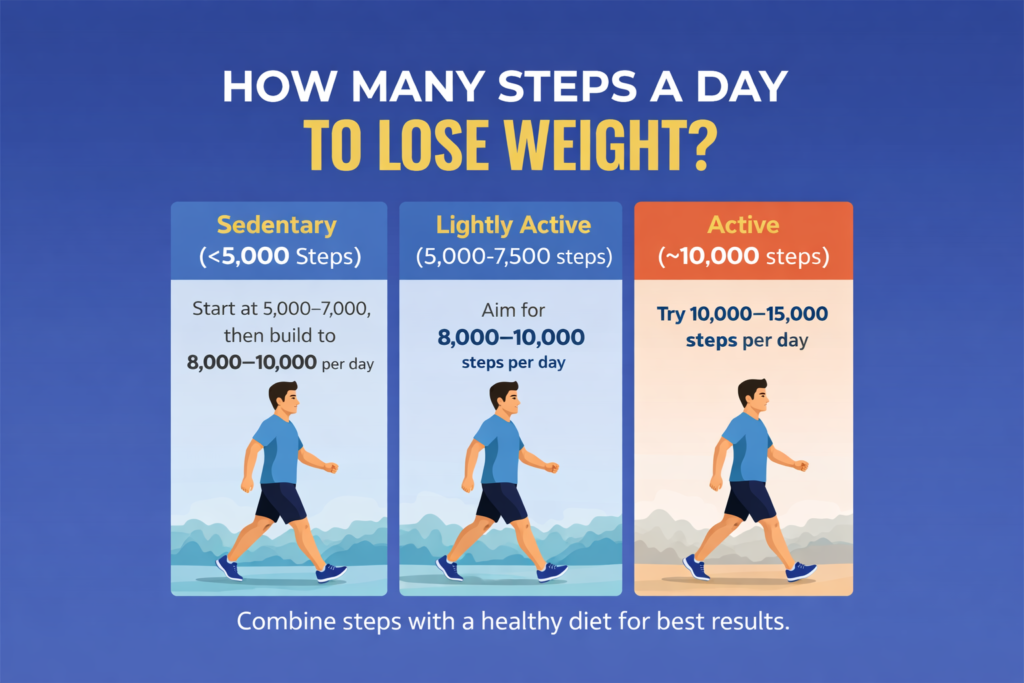
Steps to lose weight infographic

How Many Steps a Day to Lose Weight?

How Many Steps a Day to Lose Weight? Most people do not need a magical number like 10,000 steps a day to start losing weight. A more accurate answer is this: many adults can begin seeing weight-loss benefits by increasing daily movement into the roughly 7,000 to 10,000+ steps per day range, especially when walking is paired with a calorie-controlled diet and done at a brisk pace often enough to count as moderate-intensity activity. The reason this question is tricky is simple. Steps alone do not cause weight loss. Weight loss happens when your overall routine creates a calorie deficit over time, and walking is one practical way to increase daily calorie burn. The exact step number that works depends on your starting activity level, body size, speed, diet, age, and consistency. Walking matters because it is one of the easiest forms of exercise to sustain. It is low-cost, accessible for many people, and easier to recover from than harder forms of cardio. That makes it especially useful for beginners and for anyone trying to build habits that last. How many steps a day do you really need to lose weight? A practical target for weight loss is usually somewhere between 7,000 and 10,000+ steps per day, but the best target depends on how much you eat and how briskly you walk. For many people, 10,000 steps is a strong but optional target, not a requirement. What step range is realistic for most adults trying to lose weight? A useful way to think about daily steps is by range, not by one fixed number: Daily steps What it usually means Under 5,000 Low activity for many adults; usually not enough on its own for meaningful weight-loss momentum 5,000–7,000 A good improvement zone for beginners; may help, especially with diet changes 7,000–10,000 A realistic weight-loss range for many adults when paired with nutrition changes 10,000+ Often associated with better long-term results, especially when many steps are brisk 12,000+ May help some people create a larger calorie deficit, but not necessary for everyone This table reflects the broader pattern in official guidance and step research: more movement generally helps, but diet and intensity determine whether added steps translate into noticeable fat loss. Why is there no single perfect step number for everyone? There is no universal best step count because weight loss depends on total energy balance, not steps alone. Two people can walk the same number of steps and get very different results. Why do body size, pace, and diet change the result? Several factors change how effective walking is for fat loss: Body size: Larger bodies usually burn more calories per step than smaller bodies. Walking pace: Brisk walking raises heart rate and burns more energy than casual strolling. Terrain: Hills, stairs, and uneven surfaces increase effort. Diet: Walking helps, but overeating can erase the calorie deficit. Starting point: Someone going from 3,000 to 8,000 steps usually sees more impact than someone already averaging 9,000. Consistency: Results come from weeks and months, not a few high-step days. That is why “How many steps should I walk?” is really shorthand for a bigger question: How much daily movement do I need, along with better eating habits, to create a sustainable calorie deficit? What does research say about steps and weight loss? Research suggests that walking more helps with weight management, but the amount of weight lost from steps alone is often modest unless diet improves too. Studies also suggest that people who lose more weight tend to combine higher step counts with more moderate-to-vigorous walking. What do official physical activity guidelines recommend? U.S. guidance does not prescribe a specific daily step number. Instead, it recommends that adults get at least 150 minutes per week of moderate-intensity aerobic activity, such as brisk walking, plus muscle-strengthening activity at least 2 days per week. CDC also notes that people trying to lose weight and keep it off generally need a high amount of physical activity unless they also reduce calorie intake. That matters because steps are just one way to reach those active minutes. A person can hit 10,000 slow steps and still do less useful weight-loss activity than someone who walks fewer steps but at a brisk pace. What do step-count studies show about real-world outcomes? A meta-analysis of pedometer-based walking interventions in sedentary adults with overweight or obesity found that walking programs produced modest weight loss, around 1 kilogram on average, and longer programs tended to produce more loss. The same review estimated roughly 0.05 kg per week, which is useful but not dramatic. A clinical trial in previously sedentary adults with overweight or obesity found that a 10,000-step prescription led to weight loss over 36 weeks, with average changes including about 2.4 kg of body weight, lower BMI, lower fat mass, and a smaller waist. People who adhered better saw better body-composition results. Another study found that adults who successfully lost at least 10% of baseline body weight in a behavioral program were averaging about 10,000 steps per day, with roughly 3,500 of those steps performed as bouted moderate-to-vigorous activity. That suggests the quality of steps matters, not just the total. Is 10,000 steps a day necessary for fat loss? No. 10,000 steps is a useful benchmark, but it is not a medical rule and not a requirement for weight loss. Official activity guidelines are based on minutes and intensity, not on a fixed step count. The 10,000-step idea became popular partly as a simple public goal, but the evidence shows something more nuanced. For health outcomes in general, meaningful benefits often begin below 10,000 steps. A 2025 systematic review found that compared with 2,000 steps per day, 7,000 steps per day was associated with substantially lower risks across several health outcomes, including all-cause mortality and cardiovascular disease. That does not mean 7,000 steps guarantees weight loss. It means lower targets can still be meaningful, especially if they help someone move from sedentary to consistently active. Can you lose weight

How Many Steps a Day to Lose Weight? Read More »
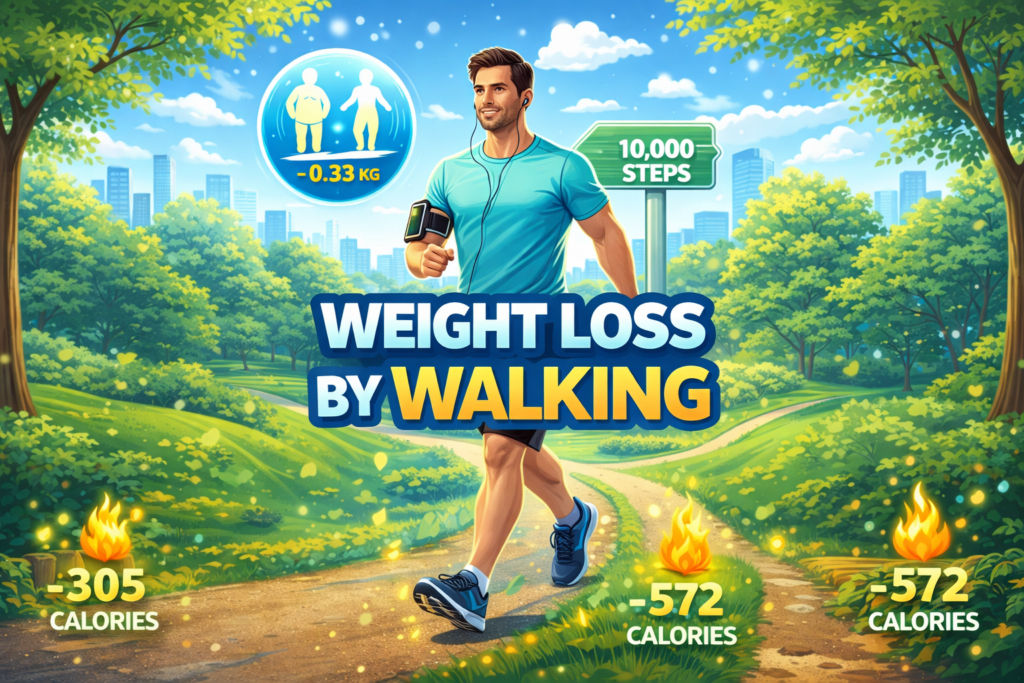
Weight loss through walking journey

Why Is Walking So Effective for Weight Loss?

Why Is Walking So Effective for Weight Loss? Walking is the most popular form of physical activity worldwide and is specifically recommended as a weight management strategy by health researchers. A JAMA Network study found that aerobic exercise like walking creates a direct dose-response relationship with fat loss—meaning the more you walk, the more weight you lose.​ Here’s something interesting: Research from Southern Methodist University discovered that traditional calorie-burning equations underestimate walking’s effectiveness in 97% of cases. You’re actually burning more calories than most fitness trackers tell you!​ Studies also show that people who maintain long-term weight loss through walking develop a better “walking economy”—their bodies are more efficient at burning energy during movement than those of individuals with obesity.​ Food Calorie Calculator How Many Steps Should You Walk Daily for Weight Loss? The magic number backed by science? 10,000 steps per day combined with proper nutrition.​ An 18-month clinical study published in the Journal of the American College of Sports Medicine found that participants who achieved 10% or greater weight loss were consistently hitting approximately 10,000 total steps daily. The research revealed:​ Each additional 1,000 steps resulted in an extra 0.21 kg of weight loss​ Each additional 1,000 moderate-to-vigorous intensity steps led to 0.33 kg more weight loss​ The sweet spot is 10,000 total steps with 3,500 of those at moderate-to-vigorous intensity in bouts of at least 10 minutes​ Studies published in JAMA confirm that walking 10,000 steps can improve cardiovascular health and reduce risks of dementia and cancer better than any pill or injection currently available.​ How Long Should Your Walking Sessions Be for Maximum Fat Burning? Duration matters—but so does how you structure your walks. A 24-week study on women with excess weight found fascinating results: those who split their 50-minute daily walk into two 25-minute sessions lost 3.7 pounds (1.7 kg) more than those who walked continuously for 50 minutes. Breaking up your walks can actually boost results!​ For meaningful weight loss, aim for: Walking Goal Duration Expected Results Modest weight loss 30 minutes, 5x weekly Gradual fat reduction ​ Significant weight loss 250+ minutes weekly (~35 min daily) Clinically measurable results ​ Accelerated fat loss 50-60 minutes daily (split sessions) Enhanced weight loss with better adherence ​ Research shows that 30 minutes of brisk walking burns approximately 137 kcal (575 kJ) for someone at a healthy weight, compared to 205 kcal (857 kJ) for someone with obesity.​ What Walking Pace Burns the Most Calories for Weight Loss? Speed directly impacts your calorie burn. Here’s the breakdown per minute based on research data:​ Walking Speed Calories Burned Per Minute 2 mph (slow pace) 2.8–3.5 calories 3 mph (moderate) 3.5–4.8 calories 4 mph (brisk) 5.2–7.2 calories Surprisingly, a study in the Journal of Sports Medicine and Physical Fitness found that walking at 5 mph burns at least as many calories as jogging at the same pace—without the joint impact.​ Brisk walking (approximately 1.52 m/s or about 3.4 mph) is the optimal speed for fat burning while remaining sustainable for longer durations.​ What Are the Best Walking Techniques to Accelerate Weight Loss? To maximize your calorie burn and speed up results, try these proven strategies: Walk in intensity bursts – Alternate 2 minutes of fast walking with 1 minute of moderate pace; research shows interval walking increases fat oxidation​ Add inclines – Walking uphill engages more muscle groups and significantly increases energy expenditure​ Break walks into two sessions – Studies prove that splitting daily walks leads to 1.7 kg more weight loss than single sessions​ Hit 3,500 MVPA steps – Of your 10,000 daily steps, aim for at least 3,500 at moderate-to-vigorous intensity in 10-minute bouts for enhanced results​ Track your pace, not just steps – Calorie burn varies significantly based on speed, so focus on walking faster rather than just walking more​ How Does Walking Compare to Other Exercises for Weight Loss? Walking offers unique advantages that other exercises can’t match. Research from the University of Kansas Medical Center confirms that consistent walking delivers cardiovascular benefits that rival pharmaceutical interventions.​ Unlike high-intensity workouts, walking: Creates no metabolic disadvantage – Long-term weight loss maintainers who walk regularly show the same exercise efficiency as people who were never overweight​ Burns more calories than estimated – Traditional equations underpredict walking calorie expenditure by a significant margin​ Supports sustainable weight maintenance – Higher levels of walking are specifically linked to long-term weight loss maintenance success​ The bottom line: Walking 10,000 steps daily—with roughly 3,500 at a brisk intensity—combined with a calorie-controlled diet creates a powerful formula for lasting weight loss.

Why Is Walking So Effective for Weight Loss? Read More »

5 Minutes of Exercise a Day Could Help You Live Longer, Study Finds

Just 5 Minutes of Exercise a Day Could Help You Live Longer For years, public health advice around exercise has focused on clear targets: 10,000 steps a day, 30 minutes of activity, or at least 150 minutes of exercise each week. While these recommendations are backed by strong science, they can feel intimidating — especially for people who are inactive, busy, older, or managing health conditions. But what if improving your health did not require a full workout or major lifestyle overhaul? Emerging research suggests that even five extra minutes of movement per day may be enough to make a meaningful difference — particularly for people who spend much of their day sitting. Instead of asking whether people hit ideal exercise benchmarks, scientists are now examining what happens when individuals make small, realistic changes to how much they move. The results are encouraging, practical, and empowering. Why Traditional Exercise Goals Can Feel Out of Reach? Exercise guidelines are designed to optimize health outcomes at a population level. For example, many health authorities recommend at least 150 minutes per week of moderate-intensity activity, such as brisk walking or cycling. These thresholds are associated with a lower risk of heart disease, diabetes, and premature death. However, there is a problem with how these goals are often perceived. For people who are already active, these targets may feel achievable or even modest. But for individuals who are largely sedentary, it can feel overwhelming. When goals feel unattainable, many people give up before they start — assuming that anything short of the ideal “doesn’t count.” This mindset may unintentionally discourage the very groups who stand to benefit the most from moving more. What New Research Reveals About Small Changes? A recent large-scale analysis published in The Lancet took a different approach to studying physical activity. Instead of focusing on whether people met established exercise guidelines, researchers asked a simpler question: What might happen if people moved just a little more each day or sat a little less? To answer this, scientists combined data from multiple long-term studies involving tens of thousands of adults across several countries. They examined levels of moderate-to-vigorous physical activity — movements that raise heart rate and breathing — as well as total time spent sitting. Rather than studying extreme changes, the researchers modeled modest, realistic shifts, such as: Adding five or ten minutes of activity per day Reducing daily sitting time by 30 to 60 minutes The goal was to estimate how these small adjustments might influence longevity when applied across large populations. Why Five Minutes Can Make a Difference? One of the most striking findings was how impactful small changes could be, especially for people who were least active to begin with. When researchers modeled a scenario where sedentary individuals added just five minutes of moderate-to-vigorous activity per day, the potential reduction in premature deaths was substantial. When similar small changes were applied across broader segments of the population, the estimated benefit grew even larger. This does not mean that five minutes of exercise magically prevents disease. Rather, it highlights an important principle: the relationship between movement and health is not all-or-nothing. Health benefits begin at very low levels of activity and increase gradually as movement increases. For someone who rarely exercises, five minutes represents a meaningful step forward — not a trivial one. The Hidden Risk of Sitting Too Much Another key insight from this research is the growing recognition that sedentary time itself is an independent health risk. Even people who meet weekly exercise guidelines may still spend large portions of their day sitting at desks, in cars, or in front of screens. Prolonged sitting has been linked to a higher risk of cardiovascular disease, metabolic disorders, and early death, regardless of exercise habits. Reducing sitting time by as little as 30 minutes per day was associated with measurable health benefits in the research models. While the effects were smaller than those seen with increased activity, they were still meaningful — particularly at a population level. This reinforces the idea that health is influenced not only by workouts but also by how we move (or don’t move) throughout the day. What Experts Say About Movement and Longevity? According to Leana Wen, an emergency physician and public health expert, this research does not replace existing exercise guidelines — but it reframes how we should think about them. Rather than viewing guidelines as a strict threshold that must be met to see any benefit, they can be understood as an aspirational target along a continuum. Every step toward more movement matters, especially for people starting from a sedentary baseline. This perspective is particularly important for older adults, people with chronic conditions, caregivers, and those with limited time or access to structured exercise environments. For these groups, modest increases in daily movement may be both more realistic and more sustainable. Who Benefits Most From Small Increases in Activity? While everyone benefits from physical activity, the largest relative gains appear among people who move the least. This includes individuals who: Spend most of the day sitting Have desk-based or driving-intensive jobs Experience mobility limitations Feel intimidated by traditional fitness culture Lack access to gyms or safe outdoor spaces For these populations, adding even a few minutes of movement per day represents a significant relative improvement. From a public health perspective, helping these groups move slightly more could prevent more disease and premature death than pushing already-active individuals to do even more. Small changes are also more likely to stick. When behaviors feel manageable, people are more likely to repeat them consistently — and consistency is what drives long-term health benefits. Rethinking Exercise as “Movement” One of the most practical takeaways from this research is a shift in mindset. Instead of thinking in terms of “exercise,” it may be more helpful to think in terms of movement. Movement does not require special equipment, gym memberships, or long time blocks. It can include: Walking briskly for a few minutes Taking the stairs

5 Minutes of Exercise a Day Could Help You Live Longer, Study Finds Read More »

How to Stay Motivated to Lose Weight Every Day (Easy Steps)

How to Stay Motivated to Lose Weight Every Day

How can you actually motivate yourself to lose weight (and keep going)? Motivation isn’t just hype or willpower. Research consistently shows that internal motivation — your personal reasons, identity, and mindset — predicts long-term weight success more than any specific diet. One large behavioral review found that people who build sustainable habits and emotional resilience maintain weight loss 2–5 years longer than those relying only on strict dieting. So the real question isn’t “How do I force myself?”It’s: How do I design a system that makes motivation easier to access every day? Let’s walk through it step by step. Read More: What grocery list makes a 1,500-calorie weight loss plan easier to follow? Read More: What are the best foods for weight loss that actually work? Read More: 10 Effective Ways to Control Obesity | Proven Weight Management Tips How Can You Stay Motivated to Lose Weight? 15 Steps (Quick Summary) Define a strong personal “why” and read it daily to stay emotionally connected to your goal Set realistic expectations — slow, steady progress lasts longer Choose a plan that fits your lifestyle instead of extreme dieting Focus on process goals (daily habits) instead of only scale results Track food, exercise, and emotions in a journal for accountability Celebrate behavior changes and small wins, not just weight milestones Build social support by sharing goals with friends or partners Use positive self-talk and avoid perfectionism Plan for setbacks like stress or holidays Improve body image and treat your body with respect Do exercises you actually enjoy to boost motivation naturally Manage stress to reduce emotional eating Increase daily movement (walking, pets, routine activity) Seek professional guidance if progress stalls Remember: motivation comes from systems and habits, not willpower alone     Why do you want to lose weight in the first place? This is the foundation. If your reason isn’t emotionally strong, motivation will collapse under stress. Studies in behavioral psychology show that intrinsic motivation (doing something for personal meaning) leads to significantly higher adherence than external pressure, such as social expectations. Instead of vague goals like: “Get healthier” “Lose weight” “Look better.” Ask deeper questions: What will change in my daily life? What can I do physically that I can’t do now? How will my energy, confidence, or relationships improve? Examples: “I want to play with my kids without getting winded.” “I want to feel confident in photos.” “I want my blood work to improve.” Write these down. Read them daily. People who regularly revisit written goals are 33–42% more likely to stay consistent with behavior change, according to goal-tracking studies. What’s a realistic expectation for weight loss? Most people quit because expectations are unrealistic. Medical guidelines from major obesity research groups recommend losing 5–10% of body weight over 6 months. That range is clinically meaningful and linked to: Reduced blood pressure Lower cholesterol Improved insulin sensitivity Reduced risk of heart disease For someone weighing 180 lbs, that’s about 9–18 lbs.For someone weighing 250 lbs, that’s about 13–25 lbs. Research shows people who aim for gradual weight loss maintain results far longer than people chasing rapid transformation. Sustainable beats dramatic. How do you choose a plan you can actually follow? The best weight loss plan is the one you can live with. Repeated crash dieting predicts future weight regain — a pattern called weight cycling. Meta-analyses show that strict “all-or-nothing” dieting increases the likelihood of binge-restrict cycles. Instead of eliminating entire food groups, research supports simple behavioral adjustments: Reducing portion sizes Eating fewer ultra-processed foods Increasing fruits and vegetables Creating a modest calorie deficit Eating regularly to avoid binge triggers Flexibility is protective. Rigidity leads to burnout. Why does exercise matter for motivation, not just calories? Exercise isn’t only about burning calories. It directly affects brain chemistry. Physical activity increases dopamine and serotonin — neurotransmitters linked to motivation, mood, and reward. A large longitudinal study found that people who exercised consistently were significantly more likely to maintain weight loss for 3+ years. The key is enjoyment. You don’t need extreme workouts. Walking, cycling, swimming, dancing, or strength training all count. People who enjoy their exercise routine are up to 70% more likely to stick with it long term. Music also helps. Studies show that listening to music increases exercise duration and perceived enjoyment. How do process goals keep you from losing motivation? Outcome goals focus on the finish line: “I want to lose 40 lbs.” Process goals focus on actions: “I’ll walk 30 minutes daily.” “I’ll eat vegetables at two meals.” “I’ll strength train twice per week.” Research in behavioral science shows process goals increase adherence because they create daily wins instead of distant pressure. You can control actions.You can’t control the scale perfectly. And motivation grows from repeated small successes. Why is tracking your habits so powerful? Self-monitoring is one of the strongest predictors of weight loss success. A major review of weight management studies found that people who track their food intake lose twice as much weight as those who don’t. Tracking increases awareness. Awareness changes behavior. A weight journal can include: Meals and snacks Emotions before eating Energy levels Sleep Exercise Stress triggers Tracking emotions helps identify patterns like stress eating or boredom snacking — key factors in long-term success. Should you celebrate progress even if the scale doesn’t move? Absolutely. Weight fluctuates for many reasons: water retention, hormones, digestion, stress, and sleep. Focusing only on scale numbers leads to frustration. Behavior change deserves celebration: You cooked more meals at home You exercised consistently You handled a craving differently You improved endurance You slept better Research shows that celebrating behavioral wins reinforces motivation pathways in the brain and increases habit persistence. Reward yourself — just not with food. Think about experiences, clothing, hobbies, or relaxation. How important is social support for weight loss? Very. Studies show people with strong social support lose more weight and maintain it longer. Accountability partners increase adherence to exercise and nutrition plans. Ways to build support: Tell family and friends your

How to Stay Motivated to Lose Weight Every Day Read More »