How Many Steps a Day to Lose Weight?
Most people do not need a magical number like 10,000 steps a day to start losing weight.
A more accurate answer is this: many adults can begin seeing weight-loss benefits by increasing daily movement into the roughly 7,000 to 10,000+ steps per day range, especially when walking is paired with a calorie-controlled diet and done at a brisk pace often enough to count as moderate-intensity activity.
The reason this question is tricky is simple. Steps alone do not cause weight loss. Weight loss happens when your overall routine creates a calorie deficit over time, and walking is one practical way to increase daily calorie burn.
The exact step number that works depends on your starting activity level, body size, speed, diet, age, and consistency.
Walking matters because it is one of the easiest forms of exercise to sustain. It is low-cost, accessible for many people, and easier to recover from than harder forms of cardio. That makes it especially useful for beginners and for anyone trying to build habits that last.
How many steps a day do you really need to lose weight?
A practical target for weight loss is usually somewhere between 7,000 and 10,000+ steps per day, but the best target depends on how much you eat and how briskly you walk. For many people, 10,000 steps is a strong but optional target, not a requirement.
What step range is realistic for most adults trying to lose weight?
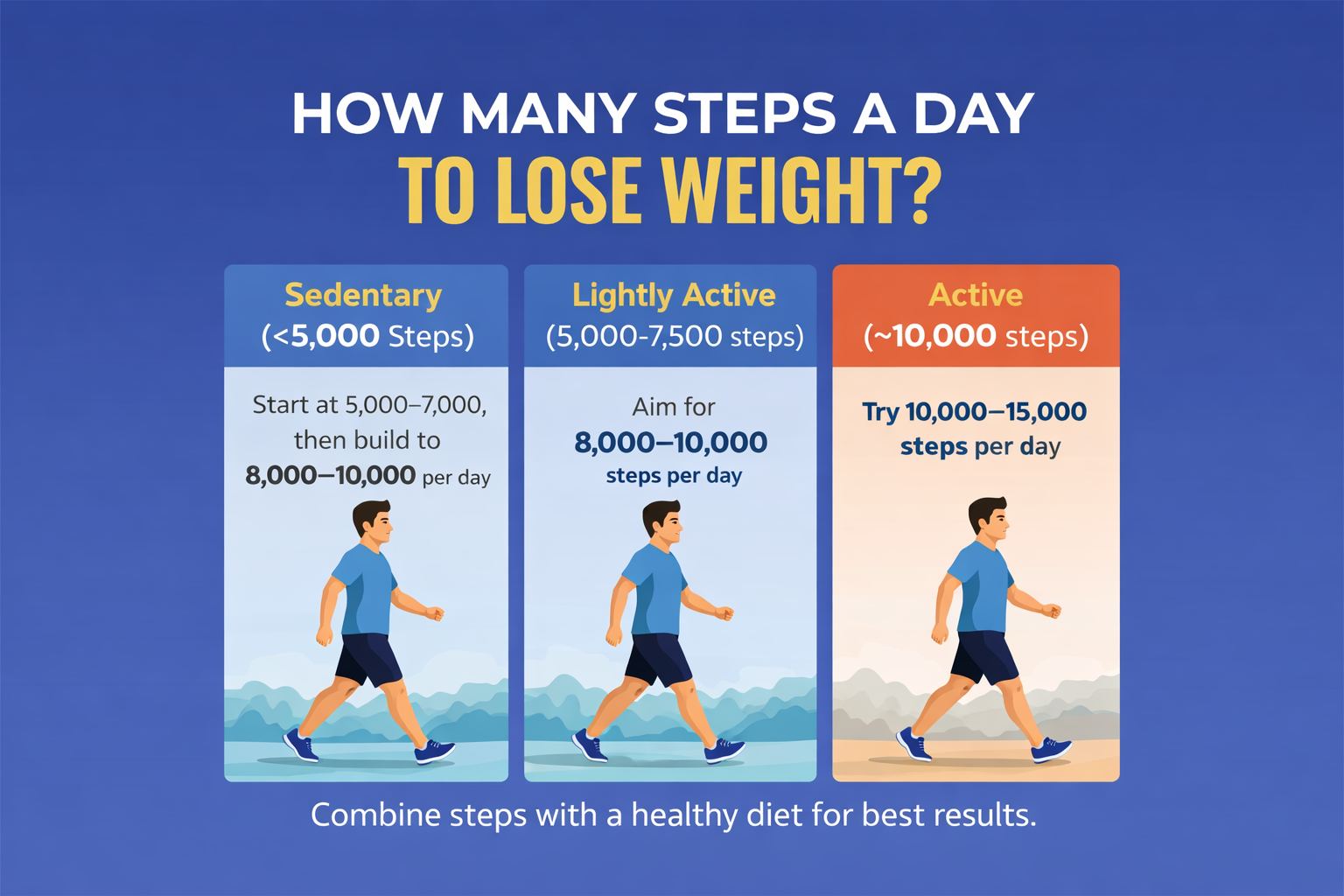
A useful way to think about daily steps is by range, not by one fixed number:
| Daily steps | What it usually means |
|---|---|
| Under 5,000 | Low activity for many adults; usually not enough on its own for meaningful weight-loss momentum |
| 5,000–7,000 | A good improvement zone for beginners; may help, especially with diet changes |
| 7,000–10,000 | A realistic weight-loss range for many adults when paired with nutrition changes |
| 10,000+ | Often associated with better long-term results, especially when many steps are brisk |
| 12,000+ | May help some people create a larger calorie deficit, but not necessary for everyone |
This table reflects the broader pattern in official guidance and step research: more movement generally helps, but diet and intensity determine whether added steps translate into noticeable fat loss.
Why is there no single perfect step number for everyone?
There is no universal best step count because weight loss depends on total energy balance, not steps alone. Two people can walk the same number of steps and get very different results.
Why do body size, pace, and diet change the result?
Several factors change how effective walking is for fat loss:
- Body size: Larger bodies usually burn more calories per step than smaller bodies.
- Walking pace: Brisk walking raises heart rate and burns more energy than casual strolling.
- Terrain: Hills, stairs, and uneven surfaces increase effort.
- Diet: Walking helps, but overeating can erase the calorie deficit.
- Starting point: Someone going from 3,000 to 8,000 steps usually sees more impact than someone already averaging 9,000.
- Consistency: Results come from weeks and months, not a few high-step days.
That is why “How many steps should I walk?” is really shorthand for a bigger question: How much daily movement do I need, along with better eating habits, to create a sustainable calorie deficit?
What does research say about steps and weight loss?
Research suggests that walking more helps with weight management, but the amount of weight lost from steps alone is often modest unless diet improves too.
Studies also suggest that people who lose more weight tend to combine higher step counts with more moderate-to-vigorous walking.
What do official physical activity guidelines recommend?
U.S. guidance does not prescribe a specific daily step number. Instead, it recommends that adults get at least 150 minutes per week of moderate-intensity aerobic activity, such as brisk walking, plus muscle-strengthening activity at least 2 days per week.
CDC also notes that people trying to lose weight and keep it off generally need a high amount of physical activity unless they also reduce calorie intake.
That matters because steps are just one way to reach those active minutes. A person can hit 10,000 slow steps and still do less useful weight-loss activity than someone who walks fewer steps but at a brisk pace.
What do step-count studies show about real-world outcomes?
A meta-analysis of pedometer-based walking interventions in sedentary adults with overweight or obesity found that walking programs produced modest weight loss, around 1 kilogram on average, and longer programs tended to produce more loss. The same review estimated roughly 0.05 kg per week, which is useful but not dramatic.
A clinical trial in previously sedentary adults with overweight or obesity found that a 10,000-step prescription led to weight loss over 36 weeks, with average changes including about 2.4 kg of body weight, lower BMI, lower fat mass, and a smaller waist. People who adhered better saw better body-composition results.
Another study found that adults who successfully lost at least 10% of baseline body weight in a behavioral program were averaging about 10,000 steps per day, with roughly 3,500 of those steps performed as bouted moderate-to-vigorous activity. That suggests the quality of steps matters, not just the total.
Is 10,000 steps a day necessary for fat loss?
No. 10,000 steps is a useful benchmark, but it is not a medical rule and not a requirement for weight loss. Official activity guidelines are based on minutes and intensity, not on a fixed step count.
The 10,000-step idea became popular partly as a simple public goal, but the evidence shows something more nuanced. For health outcomes in general, meaningful benefits often begin below 10,000 steps.
A 2025 systematic review found that compared with 2,000 steps per day, 7,000 steps per day was associated with substantially lower risks across several health outcomes, including all-cause mortality and cardiovascular disease.
That does not mean 7,000 steps guarantees weight loss. It means lower targets can still be meaningful, especially if they help someone move from sedentary to consistently active.
Can you lose weight with 5,000 to 7,000 steps a day?
Yes, you can, especially if your diet improves and your starting activity level is low. A jump from 3,000 to 6,000 or 7,000 steps may create real progress, even if it does not sound impressive on paper.
For beginners, 5,000 to 7,000 steps can be enough to:
- increase daily calorie expenditure
- reduce sedentary time
- improve adherence compared with an unrealistic target
- build a foundation for later progress
- support modest weight loss when paired with calorie control
The important point is that the best step goal is the one you can actually repeat for months. A lower sustainable target beats an ambitious target you quit after a week.
How does walking help create a calorie deficit?
Walking helps with weight loss by raising total daily energy expenditure. If calorie intake stays the same, extra movement can help create the calorie deficit needed to lose body fat.
But walking alone has limits. CDC states that healthy weight loss usually comes from a full lifestyle approach that includes healthy eating patterns, regular physical activity, enough sleep, and stress management.
CDC also notes that a gradual pace of 1 to 2 pounds per week is more likely to be maintained than faster loss.
In practice, that means:
- Steps can increase calorie burn.
- Better food choices can lower calorie intake.
- Combining both usually works better than either one alone.
- Sleep and stress matter because they affect hunger, cravings, and consistency.
How fast should you walk for weight loss?
For weight loss, brisk walking is usually more effective than very easy walking because it counts as moderate-intensity activity and burns more calories per minute. CDC describes brisk walking as a moderate-intensity activity and gives walking at about a 15-minute mile pace as an example.
What counts as brisk walking?
A brisk pace usually means:
- Your breathing is noticeably faster
- Your heart rate is up
- You can still talk, but singing would be difficult
- You are walking with purpose rather than strolling
For many people, making some of their daily steps brisk is the easiest way to make walking more effective without needing extreme step totals.
What step goal should beginners start with?
Beginners should usually start above their current baseline, not at 10,000 immediately. A smart target is often 1,000 to 2,000 steps above your normal daily average, then increases gradually as your body adapts. This approach improves adherence and lowers the risk of burnout. That progression principle also fits broader public-health advice to work up gradually toward recommended activity levels.
A practical beginner progression looks like this:
- Track your current average for 5 to 7 days.
- Add 1,000 daily steps.
- Hold that target for 1 to 2 weeks.
- Add another 500 to 1,000 steps if recovery feels good.
- Introduce brisk walks before chasing very high totals.
Someone averaging 3,500 steps might progress to 4,500, then 5,500, then 6,500, and later aim for 7,500 or more.
What step goal works better if you want faster or more noticeable results?
If your goal is more noticeable weight loss, higher activity volumes usually work better than the bare minimum, especially when paired with moderate calorie restriction.
ACSM’s position stand concluded that 150 to 250 minutes per week of moderate-intensity activity tends to produce only modest weight loss, while more than 250 minutes per week is associated with clinically significant weight loss.
How many weekly active minutes matter for weight loss?
This is where daily steps and time-based exercise overlap:
- 150 minutes/week: strong health baseline
- 150–250 minutes/week: often modest weight loss
- 250+ minutes/week: better odds of clinically meaningful weight loss
- 225–250+ minutes/week after weight loss: often important for keeping weight off
For many people, hitting 8,000 to 12,000 steps per day with several brisk walks each week is one practical way to reach that higher activity volume. That is not a universal rule, but it is a realistic pattern for many adults trying to lose weight.
How should you combine steps, diet, and strength training?
The best fat-loss plan is not “walk more and hope.” The best plan is to walk more, eat more intentionally, and preserve muscle. CDC and other official guidance consistently frame weight management as a combined lifestyle issue, not a step-only issue.
A strong routine usually includes:
- Daily steps: to raise total movement and calorie burn
- Brisk walking or cardio sessions: to increase moderate-intensity minutes
- Strength training 2 days per week or more: to support muscle mass and body composition
- A sustainable calorie deficit: to make weight loss actually happen
- Sleep and stress support: to improve adherence and appetite control
Strength training matters because losing weight without preserving muscle can make progress harder to maintain.
What mistakes make walking less effective for weight loss?
The biggest mistake is assuming steps automatically equal fat loss. Walking helps, but it does not override excess calorie intake.
Common mistakes include:
- Overestimating calories burned.
Trackers are helpful, but their calorie estimates are not perfect. - Walking all the time slowly.
Easy steps are still useful, but brisk steps usually do more for fitness and calorie burn. - Keeping the same goal forever.
If 6,000 steps became easy months ago, your body may need a larger training load or better nutrition control. - Ignoring food intake.
A short walk does not cancel frequent overeating. CDC explicitly ties healthy weight to both physical activity and eating patterns. - Going too aggressive too fast.
Jumping from 3,000 to 12,000 steps overnight often leads to soreness, poor adherence, or injury.
How can you build a realistic daily step plan?
The most effective step plan is one that matches your real life. Start from your baseline, increase gradually, and make some walking brisk enough to count as moderate intensity.
How should you progress your step target over time?
Use this simple framework:
Week 1: Track your normal average.
Week 2–3: Add 1,000 steps per day.
Week 4–5: Add another 500 to 1,000 steps.
Week 6+: Add brisk 10- to 30-minute walking sessions 3 to 5 times per week.
After that: Decide whether your priority is health, fat loss, or maintenance.
A sample approach by goal:
- General health: 6,000 to 8,000 steps plus brisk walks
- Gradual weight loss: 7,000 to 10,000+ steps plus calorie control
- More aggressive but sustainable fat loss: enough daily steps and brisk walking to help you reach 250+ moderate minutes per week, while maintaining a realistic calorie deficit
What are the key takeaways about steps and weight loss?
Here is the shortest accurate answer: you do not need exactly 10,000 steps a day to lose weight, but many people will do well aiming somewhere in the 7,000 to 10,000+ range, with some of those steps taken briskly and with diet adjusted to create a calorie deficit.
Key Takeaway
- There is no single magic step number for fat loss.
- 10,000 steps is helpful, not mandatory.
- 5,000 to 7,000 steps can help beginners, especially with diet changes.
- 7,000 to 10,000+ steps is a realistic target range for many adults trying to lose weight.
- Brisk walking works better than casual walking for time efficiency.
- Diet plus walking beats walking alone for weight loss.
- Higher activity volumes, often 250+ moderate minutes per week, improve the odds of meaningful results.
FAQ: How many steps a day to lose weight?
Can 5,000 steps a day help you lose weight?
Yes. 5,000 steps can help, especially if you were previously very sedentary and you also improve your diet. It may be enough for early progress, but many people need more activity over time for larger results.
Is 7,000 steps enough for weight loss?
It can be. 7,000 steps is a solid target for many adults, particularly when the steps include brisk walking and the eating pattern supports a calorie deficit. Research also shows that 7,000 steps is linked with meaningful health benefits compared with very low step counts.
Do you need 10,000 steps a day to lose belly fat?
No. You do not need exactly 10,000 steps to reduce body fat, including abdominal fat. Belly fat is reduced through overall fat loss, which comes from sustained calorie deficit and regular activity, not from one exact step number.
Is 12,000 steps better than 10,000 for weight loss?
Sometimes, yes. More steps can help if they increase your total weekly activity and calorie burn, but the extra benefit depends on recovery, pace, diet, and whether the higher target is sustainable. More is not always better if it leads to burnout.
How long does it take to lose weight by walking?
Results vary, but walking-based programs often produce gradual changes over weeks to months, not overnight. CDC says a healthy pace of weight loss is usually about 1 to 2 pounds per week.
Is walking enough without dieting?
Sometimes, but often not. Walking alone can lead to modest weight loss, yet bigger and more reliable results usually happen when walking is combined with healthier eating patterns.
What pace should you walk for fat loss?
A brisk pace is usually best. CDC classifies brisk walking as moderate-intensity activity and gives about a 15-minute mile as an example.
Conclusion
The best answer to “How many steps a day to lose weight?” is not a slogan. It is this: walk more than you do now, make at least some of it brisk, pair it with a calorie deficit, and stay consistent long enough for the math to work. For many people, that means building toward 7,000 to 10,000+ daily steps instead of obsessing over one perfect number.