Can an 8-minute morning routine to reduce back pain really help all day?
An 8-minute morning routine to reduce back pain can meaningfully ease stiffness, support your spine, and lower pain sensitivity throughout the day when you practice it consistently. Global data shows that lower back pain affects around 619 million people worldwide, and up to 80% of adults experience it at least once, so a simple daily strategy is a powerful way to protect your spine.
Why an 8-minute morning routine to reduce back pain matters
While you sleep, your spine unloads, and your discs rehydrate, which makes them slightly thicker and your back up to about 20% stiffer when you first wake up. That extra stiffness means your tissues are more sensitive to bending, twisting, and slouching in the early hours.
If your first move is to fold forward to grab your phone, tie your shoes, or rush chores in a hunched position, your nervous system may react defensively and tighten your muscles to “protect” the spine. That’s why so many people feel their back “lock up” doing something as small as picking up a sock. An 8-minute morning routine to reduce back pain gently reintroduces safe movement before your spine has to carry weight, stabilize you, or handle sudden loads.
How an 8-minute morning routine to reduce back pain works
Pain science research shows that slow, controlled movement paired with longer, calm exhales activates your parasympathetic nervous system—the “rest and digest” side that relaxes muscles and reduces nervous system arousal. Deep, slow breathing has also been shown to change pain perception and autonomic activity, helping your body process pain signals more calmly.
This 8-minute morning routine to reduce back pain is built around four evidence-backed ideas:
-
Restoring alignment (rib cage, pelvis, and spine stacking better)
-
Reintroducing motion safely with low load and slow pacing
-
Activating key support muscles like your glutes and core
-
Avoiding aggressive stretching that can irritate already sensitive tissues
The goal is simple: readiness, not fatigue. You should finish feeling more stable and mobile—not sweaty or wiped out.

Step 1: Breath-led decompression in an 8-minute morning routine to reduce back pain (90 seconds)
-
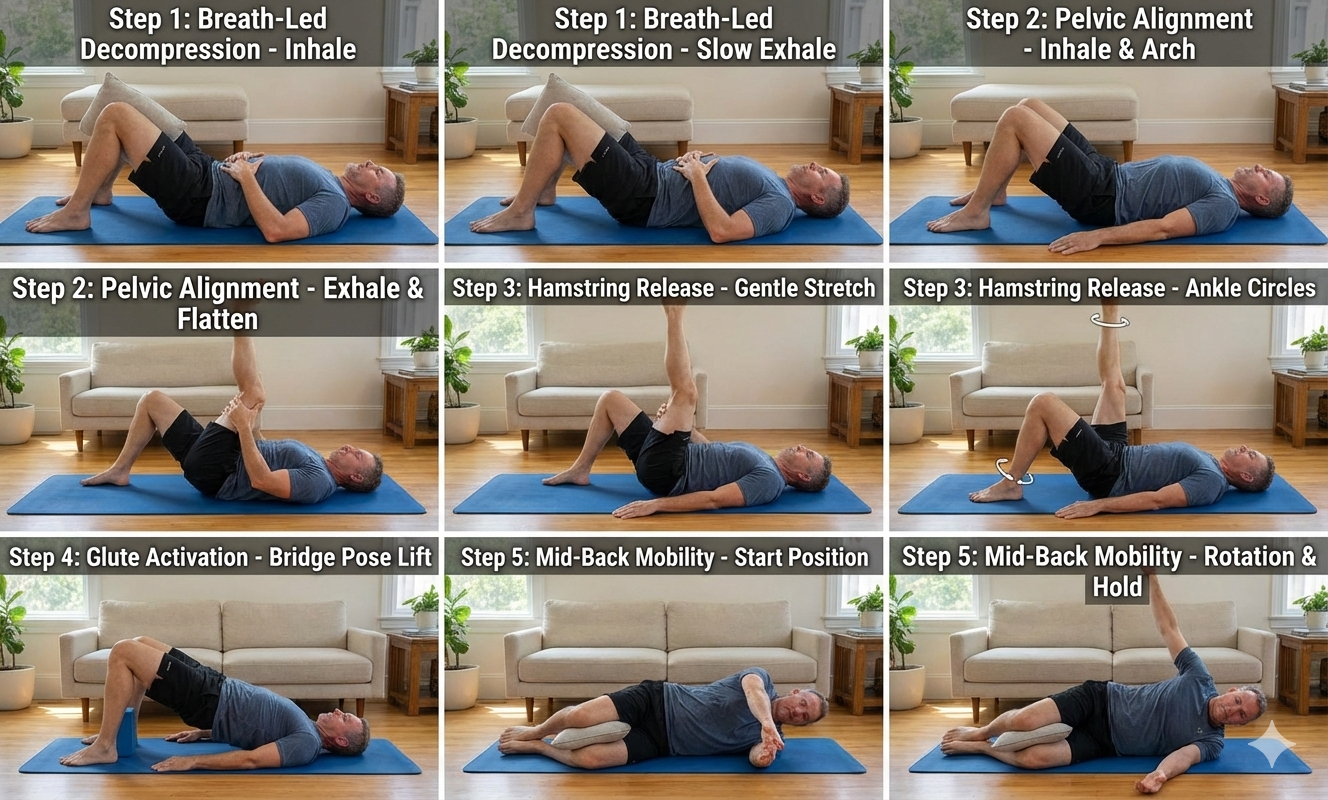
Lie on your back with your knees bent, feet hip-width apart.
-
Place a pillow or yoga block between your knees and rest your hands on your lower ribs.
-
Use a 5–7–3 breathing pattern for six breaths:
-
Inhale through your nose for 5 seconds
-
Exhale slowly for 7 seconds
-
Pause gently for 3 seconds
-
Longer, slower exhalations have been shown to shift your body toward parasympathetic dominance, lowering muscle tone and stress reactivity. This breath-led decompression in an 8-minute morning routine to reduce back pain helps your rib cage and pelvis settle into better alignment and reduces unnecessary spinal compression before you start moving.

Step 2: Pelvic alignment in an 8-minute morning routine to reduce back pain (90 seconds)
Stay on your back with your knees bent and continue the same breathing pattern.
-
Inhale and gently tilt your pelvis forward, creating a small natural arch in your lower back.
-
Exhale and tilt your pelvis backward, lightly flattening your lower back into the floor.
-
Move slowly for six breaths, then pause in a neutral, comfortable middle position.
This pelvic alignment work in an 8-minute morning routine to reduce back pain reintroduces lumbar motion without loading the spine, which is especially important when discs are more hydrated and stiff in the morning. Research links poor pelvic control and altered pelvic mechanics to a higher risk of chronic low back pain, so improving this control can be a meaningful preventative strategy.

Step 3: Hamstring release in an 8-minute morning routine to reduce back pain (1 minute)
-
From the same position, straighten one leg toward the ceiling while the other foot stays on the floor.
-
Keep your head relaxed and stop at a mild, comfortable stretch—no forcing.
-
While holding the leg, spread your toes and slowly circle your ankle for about 30 seconds.
-
Switch sides.
Tight hamstrings attach to the pelvis and can tilt it, which increases strain on the lumbar spine during standing and walking. Biomechanical research shows that increased hamstring tension correlates with higher lumbar loading, so this hamstring release in an 8-minute morning routine to reduce back pain helps reduce that pull before you spend the day on your feet.

Step 4: Glute activation in an 8-minute morning routine to reduce back pain (2 minutes)
-
Place the pillow or block back between your knees.
-
Exhale and tilt your pelvis backward to lightly flatten your lower back.
-
At the end of your exhale, press through your feet and lift your hips just a few inches into a gentle bridge.
-
Hold for three steady breaths, then lower slowly.
-
Repeat three times.
Many studies find that people with chronic low back pain often show reduced glute strength or control and altered pelvic alignment, which can shift more work onto the low back muscles. In one 2024 study, targeted gluteal control training significantly improved pelvic alignment and reduced pain and dysfunction in people with chronic low back pain. This glute activation step in an 8-minute morning routine to reduce back pain teaches your hips—not your lower back—to handle more of the load when you walk, climb stairs, or lift.

Step 5: Mid-back mobility in an 8-minute morning routine to reduce back pain (2 minutes)
-
Lie on your side with your knees bent at 90 degrees and a pillow between them.
-
Support your head with a pillow or your arm.
-
Extend both arms forward at shoulder height.
-
Inhale and slowly open your top arm across your body, rotating from your mid-back (thoracic spine) and letting your head follow.
-
Only go as far as is comfortable, without forcing or feeling strain in your lower back.
-
Hold for five slow breaths, then switch sides.
The thoracic spine is designed for rotation, while the lower back is built more for stability than twisting. When your mid-back gets stiff, research shows compensatory motion tends to occur in the lumbar region, increasing strain and potentially contributing to pain. This thoracic rotation work in an 8-minute morning routine to reduce back pain, restores mid-back movement so your lower back does not have to absorb unnecessary twisting forces.
Why an 8-minute morning routine to reduce back pain beats occasional stretching
Chronic back pain usually follows patterns driven by daily habits, not just isolated incidents. Clinical research consistently shows that frequent, low-intensity mobility work improves joint health, reduces pain recurrence, and supports better posture over time.
That’s why a short, daily 8-minute morning routine to reduce back pain can be more effective than a long, aggressive stretching session done once a week. Regular, gentle movement trains your nervous system to feel safer with motion, improves muscle coordination around the spine, and gradually reshapes your posture as a day-to-day behavior—not just a one-off correction.
Long-term benefits of an 8-minute morning routine to reduce back pain
People who commit to a daily spine-friendly routine often report:
-
Less morning stiffness and easier first steps out of bed
-
Improved posture and more natural alignment during sitting and standing
-
Fewer flare-ups and less fear of everyday movements like bending or lifting
-
Better movement confidence and overall quality of life
From a numbers perspective, an 8-minute morning routine to reduce back pain adds up quickly: 8 minutes a day equals about 56 minutes a week and more than 48 hours of intentional spinal care over a year. That kind of consistent, low-intensity investment is exactly the pattern associated with meaningful long-term improvements in chronic pain and function.
If you wake up stiff, think of this routine as “warm-up time” for your spine—just like athletes warm up before a game—so your back is prepared to handle the real-world movements you’ll ask of it all day.